| Perspectives | Methods | Meaning | Reference |
|---|---|---|---|
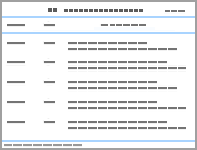
| Greenspace patch area | Piecewise linear regression models | Establish a buffer zone to calculate the threshold for greenspace patch cooling capacity and efficiency. | (Tang et al., |
| Greenspace pattern | Landscape pattern index | Emphasize the ability of greenspace structures to enhance cooling effects. | (Wang et al., |
| Morphological spatial pattern of greenspace | Morphological spatial pattern analysis (MSPA) | Emphasize that greenspace connectivity can improve urban microclimates. For example, enhancing connectivity between core areas and their edges can effectively alleviate heat discomfort. | (Lin et al., |
| Greenspace accessibility | 2SFCA/3SFCA | Emphasize that residents can measure the accessibility of large greenspace within a certain time frame (such as fifteen minutes) using various modes of transportation (walking, biking, and driving). This serves as a distance-based exposure indicator (Xie et al., | (Zeng et al., |
| The degree of interaction between greenspace and people | Population-weighted greenspace exposure | Emphasize that, from the perspective of population exposure, planning greenspace can guide population movement to adapt to future climate comfort. This reflects the fairness and rationality of greenspace resource allocation in urban planning. | (Zhang et al., |
| Dynamic population- weighted greenspace exposure | This approach considers both spatial and temporal dimensions of greenspace resources, emphasizing their accessibility and availability within specific areas. Therefore, it can be used to measure the actual usage of greenspace by population in different regions at various time periods. | This study |