Special Issue: Human, Civilization Evolution and Environmental Interaction

Paleoenvironmental reconstruction of human adaptation in the Nihewan Basin of North China during Middle Pleistocene: A case study of Jijiazhuang archaeological site

  • PEI Shuwen , 1, 2 ,
  • XU Jingyue 1, 2, 3 ,
  • DU Yuwei 1, 2, 3 ,
  • YE Zhi 1, 2, 3 ,
  • GENG Shuaijie 1, 2, 3 ,
  • LIU Ziyi 1, 2, 3
Expand
  • 1. Key Laboratory of Vertebrate Evolution and Human Origins, Institute of Vertebrate Paleontology and Paleoanthropology, CAS, Beijing 100044, China
  • 2. Key Scientific Research Base on Paleolithic Human Evolution and Paleogenetics (IVPP), SACH, Beijing 100044, China
  • 3. University of Chinese Academy of Sciences, Beijing 100049, China

Pei Shuwen (1968-), Professor, specialized in geoarchaeology and Paleolithic archaeology. E-mail:

Received date: 2024-11-08

  Accepted date: 2025-01-16

  Online published: 2025-09-04

Supported by

National Natural Science Foundation of China(42371165)

National Natural Science Foundation of China(41872029)

Abstract

Situated in the semi-arid regions of North China, the Nihewan Basin documents the fluvio-lacustrine sequence and Pleistocene archaeological sites, offering an excellent opportunity to investigate human adaptation to environmental change in East Asia, especially in North China. However, paleoenvironmental datasets from Middle Pleistocene archaeological sites are not fully understood. Focusing on the evidence from the 0.63-0.49 Ma-old site of Jijiazhuang (Nihewan Basin, North China), this paper presents the results of various environmental indicators from the site context. Moreover, it explores the links between hominin behavioral adaptations and ecological variability during the extra-long interglacial period in North China. Sedimentological features of the excavated section indicate that the site was formed in the margin of the Nihewan paleolake. Based on well-constructed pollen, sediment grain size, color reflectance, and major geochemical element analyses, five stages of environmental changes were identified during site formation. This study indicates that hominins occupied the site at the early part of Stage 2, when the Nihewan paleolake had a relatively low water level and the climate was temperate, with strong weathering intensity dominated by wooded grassland landscapes. In conclusion, the results suggest that the extra-long duration of interglacial or mild stadial climate events (MISs 15-13) in the Northern Hemisphere may have provided favorable conditions for increased technological innovations and adaptive strategies among Middle Pleistocene hominins in the Nihewan Basin even in North China.

Cite this article

PEI Shuwen , XU Jingyue , DU Yuwei , YE Zhi , GENG Shuaijie , LIU Ziyi . Paleoenvironmental reconstruction of human adaptation in the Nihewan Basin of North China during Middle Pleistocene: A case study of Jijiazhuang archaeological site[J]. Journal of Geographical Sciences, 2025 , 35(8) : 1601 -1618 . DOI: 10.1007/s11442-025-2386-4

1 Introduction

The Middle Pleistocene witnessed significant paleoenvironmental fluctuations that influenced human evolution and behavioral adaptations (Potts, 1996, 1998; Abbate and Sagri, 2012; Sandweiss and Kelley, 2012; Grove, 2014, 2017; Ao et al., 2017, 2020; Potts et al., 2018; Zan et al., 2024). China has proven to be an indispensable region for understanding the long evolutionary period of Homo erectus and its behavioral adaptations to climatic fluctuations in eastern Eurasia (Bae, 2010; Wu et al., 2014, 2019; Xing et al., 2016, 2018; Athreya and Wu, 2017; Liu et al., 2017, 2019, 2022; Yang et al., 2021; Bae et al., 2023). One important issue that still needed to be established is whether climatic variation provided favorable conditions for the increased morphological variability of human evolution and triggered human adaptive innovations during the Middle Pleistocene (Ao et al., 2017, 2020; Sun et al., 2017, 2018; Bae et al., 2018; Liu et al., 2022; Qin and Sun, 2023). Therefore, identifying and characterizing specific ecological niches at the local level is critical to our understanding of human adaptive behaviors corresponding to climate fluctuations and environmental changes in the region.
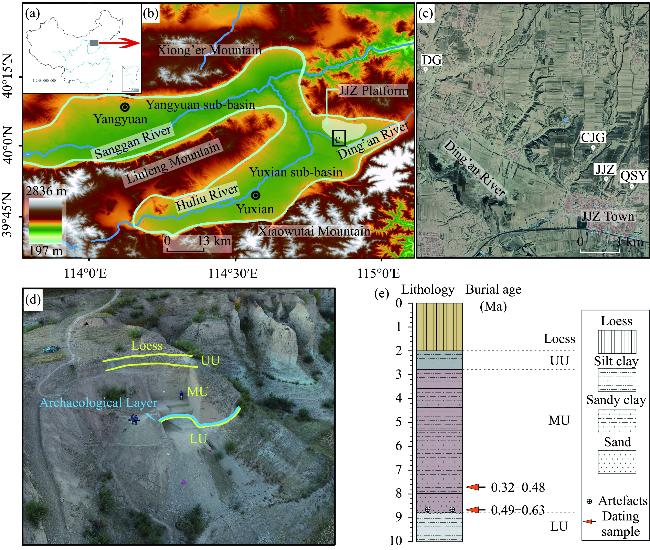
An important area in these discussions is the Nihewan Basin of North China, which is located in the transitional zone between the North China Plain and the Inner Mongolian Plateau and comprises three sub-basins: Datong, Yangyuan, and Yuxian (Wei, 2006; Figures 1a and 1b). The Nihewan Basin contains well-preserved fluvio-lacustrine deposits and the densest concentration of Pleistocene Paleolithic sites outside Africa, which provide valuable data for exploring the effects of environmental variability on human evolution and behavioral adaptations. Current evidence indicates that recurrent hominin occupation of the Nihewan Basin occurred from 1.66 to 0.4 Ma (Zhu et al., 2004; Deng et al., 2008), overlapping largely by more than one million years. In the past few decades, environmental reconstructions of how climatic fluctuations affected human behavior were derived from the Early Pleistocene archaeological context. This indicates that environmental fluctuations and diversified landscapes may have driven flexibility in various aspects of early human technological behaviors, allowing hominins to face the environmental challenges of northern latitudes during the Middle Pleistocene Climate Transition (Pei et al., 2009; Xu et al., 2021, 2023). Current evidence shows that the Middle Pleistocene may have witnessed technological innovations in the Nihewan archaeological sequence (Yang et al., 2020), but the driving mechanisms for such behavioral adaptation have not yet been ascertained.
Figure 1 Geographical and geochronological background of the Jijiazhuang site in the Nihewan Basin. (a-b) Location of the Nihewan Basin (Drawing review No.GS(2016) 1594); (c) Google Earth image showing location of key archaeological sites in the Jijiazhuang Platform; (d) Photo showing the geomorphological setting of the Jijiazhuang site; (e) Stratigraphic sequence and cosmogenic burial ages of Jijiazhuang site. Abbreviations of the strata unit and the sites: Loess (Yellow color in the lithology); UU-Upper Unit (Dark gray color in the lithology); MU-Middle Unit (Brown gray color in the lithology); LU- Lower Unit (Light gray color in the lithology); JJZ-Jijiazhuang site; QSY-Qianshangying site; CJG-Caijiagou site; DG-Donggou site.
The Yuxian sub-basin, located in the southeastern part of the Nihewan Basin (senso lato; Figure 1b), preserves hundreds of meters of Early-Middle Pleistocene fluvio-lacustrine deposits. In the past decade, more than 20 archaeological sites have been found in the sub-basin, offering a unique opportunity to investigate Middle Pleistocene human adaptation in the Nihewan Basin. The Jijiazhuang Paleolithic site (JJZ) (40°01′25″N, 114°51′15″E, elevation 916 m) is one of the representative sites from the Yuxian sub-basin (Pei et al., 2018; Figure 1c). Cosmogenic 26Al/10Be burial dating indicates that early humans occupied the site during the early part of the Middle Pleistocene. The lithic assemblage shows advanced features of relatively long-distance resource procurement and standardized, extensive, and refined shaping strategies (Ye et al., 2024). In this study, we present the results of the paleoenvironmental reconstruction using well-constructed pollen, sediment grain size, and major element analysis in the context of the JJZ site. By combining our results with behavioral strategies from JJZ site, we attempt to reconstruct paleo-landscapes and environmental variability, and try to contextualize the dynamics observed in the adaptive strategies adopted by early humans in the site even the Nihewan Basin during the Middle Pleistocene.

2 Site background

2.1 Geological background

The Yuxian sub-basin is an inter-montane down-fault induced basin in the southeastern part of the Nihewan Basin (Figures 1a and 1b). Current evidence indicates that the Yuxian sub-basin has been integrated into the Nihewan paleolake through the Huliu River Graben since the Late Pliocene (Xia and Liu, 1984; Zhou et al., 1991; Tang et al., 2020). As an important constituent of the Nihewan Basin, the Yuxian sub-basin exhibits the same evolutionary processes as the Nihewan paleolake that formed during the Pliocene (Deng et al., 2008; Yuan et al., 2009; Ao et al., 2013) and ultimately ceased to exist around 260 ka (Zhao et al., 2010; Guo et al., 2016; Deng et al., 2019). Consequently, fluvio-lacustrine sediments have accumulated widely in the Yuxian sub-basin (Tang and Ji, 1983; Chen, 1988; Yuan et al., 2009, 2011; Deng et al., 2019). Currently, thick and continuous exposures of these fluvio-lacustrine sequences are found mainly along the SW-NE trending Huliu River and the SE-NW trending Ding’an River on the northeast margin of the Yuxian sub-basin (Figure 1b). Notably, the Middle Pleistocene typical fluvio-lacustrine deposits (up to 30 m in thickness) were exposed in the JJZ Platform (Pei, 2017; Pei et al., 2018; Ma et al., 2021) to the northeastern margin of the Yuxian sub-basin, covering an area of some 10 km2 with a local elevation of >50 m (Figures 1b and 1c).

2.2 Stratigraphy and chronology

The JJZ section is located in the central part of the JJZ Platform, where several Middle and Late Pleistocene Paleolithic sites have been discovered (Fig. 1c). The fluvio-lacustrine deposits were 20 m thick and consisted mainly of greyish-yellow and grayish-green silty clays, silts, and sands. The stratigraphic sequence was eroded and cut by modern streams from the northern mountainous area, which resulted in small valleys interspersed within the sequence as a modern landscape (Figure 1d). Archaeological excavation indicates that the archaeo-stratigraphic sequence can be classified into the Lower Unit (LU, 15 m-thick), Middle Unit (MU, 8 m) and Upper Unit (UU, 0.5 m), which are capped by loess sediments. In the key trench of JJZ, the stratigraphic section can be classified into 9 layers across the LU (layer 9 of 1.2 m), MU (layers 8-4 of 6 m), and UU (layers 2-3 of 0.8 m), overlain by loess deposits (layers 1-2 of 2m). The archaeological occurrences of the JJZ site are placed in lake shore sands, silts and clays from the upper part of layer 9 of the LU (Pei et al., 2018; Ye et al., 2023; Figures 1d and 1e).
The long fluvio-lacustrine sequences in the Nihewan Basin are devoid of suitable material for radiometric dating; therefore, magnetostratigraphy was used to estimate the age of the Early Pleistocene Paleolithic sites in the Nihewan Basin (e.g., Zhu et al., 2004, 2007; Pei et al., 2019). Although this was a major breakthrough, archaeological records of the Middle Pleistocene lacustrine deposits remain scarce. As a new dating technique that enabled the establishment of a precise age for archaeological deposits from the Middle Pleistocene, the cosmogenic 26Al/10Be burial dating method was performed to estimate the burial ages of the JJZ site. The result indicates that early humans occupied the site between 0.49 ± 0.10 and 0.63 ± 0.11 Ma (Pei et al., 2018; Du et al., 2023; Ye et al., 2024; Figure 1e), corresponding to the extra-long interglacial period of MISs 15-13.

2.3 Archaeology

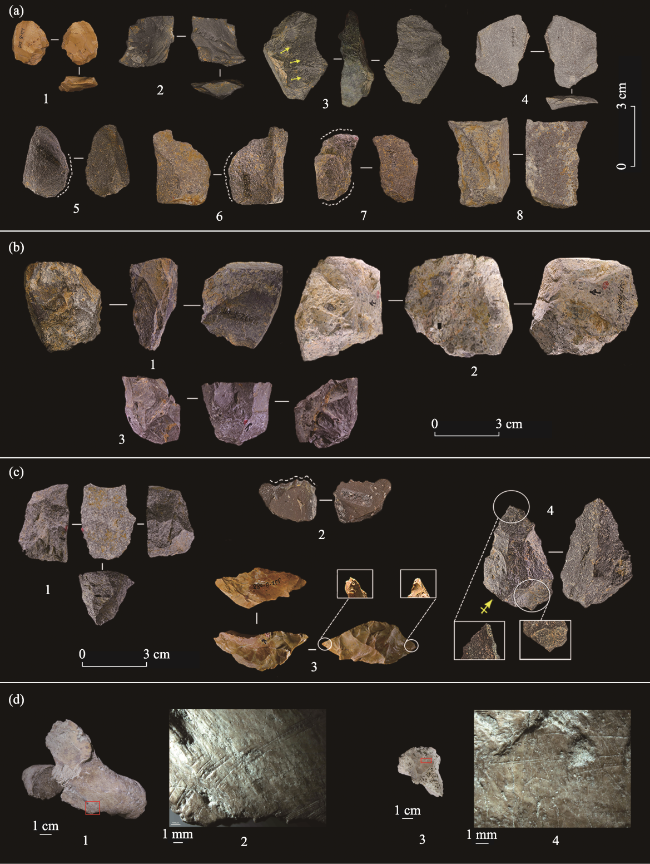
The JJZ site was discovered in 2003 and 2016. Excavation during the 2016 and 2018 field seasons covered a total area of 146 m2. Archaeological remains were unearthed from the archaeological layers in each trench. The JJZ lithic assemblage consists of 255 artifacts, which were classified into cores (n = 22, 8.6%), retouched tools (n = 26, 10.2%), detached pieces (n = 205, 80.4%), and pounded artifacts (n = 2, 0.78%) (Figures 2a-2c). The JJZ knappers intentionally procured raw materials from relatively long distances and displayed significant changes in retouching strategies, reminiscent of Middle Paleolithic technologies. When compared with the Early Pleistocene assemblages, the behavioral patterns of JJZ contradict the traditional view of the long stasis of Mode 1 in the Nihewan Basin, even in North China (Pei et al., 2018; Du et al., 2023; Ye et al., 2024).
Figure 2 Selected lithic artifacts and animal bones from JJZ site. (a) Flakes: 1. Bipolar flake; 2, 4. Freehand percussion flakes; 3. Core-edge flake; 5-7. Flake with use wear; 8. Elongate flake. (b) Cores: 1-2. Multifacial cores; 3. Unifacial core. (c) Retouched tools: 1. Scraper; 2. Denticulate. 3. Bore; 4. Point. (d) animal bones: 1-2. A cervical vertebrate with carnivore tooth marks and percussion marks; 3-4. An occipital condyle with carnivore tooth marks overlying cutmarks.
In addition, the JJZ archaeological layers preserved 464 mammalian fossils, including Equus, Rhinocerotidea, Cervus, Gazella and Bovidae, with Equus dominating the fauna assemblage (Du et al., 2023). Preliminary studies have shown that animal bones from the JJZ site are largely preserved in their primary context, and early humans seemed to have primary access to animal carcasses. The construction of the body part profiles of the main animal species form JJZ indicated no apparent trend in the selective transport of animal parts at the site. The presence of cut marks demonstrates a variety of human subsistence activities such as skinning, dismembering, and defleshing, once undertaken by hominins at the site (Figure 2d). Percussion traces registered on animal bones testify to the marrow extraction strategies of JJZ inhabitants. However, the limited number of animal bones and stone artifacts implies that hominin presence at this site was probably short-lived in nature. Carnivores might have secondarily ravaged the animal parts left behind, thus imposing tooth marks over human butchery marks (Du et al., 2023).

3 Sampling and methods

All samples used for the integrated pollen record, together with grain size, color, and major element analysis, were provided for the fluvio-lacustrine section at the JJZ site. A total of 85 samples were collected from the western wall of JJZ-B section excavated in 2018. Samples were taken at 10 cm intervals through the fluvio-lacustrine section.
The pollen samples were processed using heavy liquid separation (Moore and Webb, 1978; Li and Du, 1999) and acetolysis (Erdtman, 1960). Lycopodium tablets were added to the samples to estimate pollen concentrations (Peck, 1974). Pollen morphological keys have been used to identify pollen taxa (e.g., Xi and Ning, 1994; Wang et al., 1997). Pollen percentages were calculated from the sum of total terrestrial pollen grains identified in each pollen spectrum.
Grain size analysis was performed using a Malvern 2000 Laser (Malvern Instruments). The instrument is calibrated from 0.02 μm to 2000 μm, with a grain size resolution of 0.01 Φ, and its repeated measurement error is less than 2%. All samples were pretreated with 10-20 ml of 30% H2O2 and 10ml of 10% HCl solution for 48 h to remove organic matter and calcareous cement, respectively (Lu and An, 1998). They were then dispersed by ultrasonic oscillation using 10 ml of 10% (NaPO3)6 solution for 10 min before measurement.
Sediment color measurements were performed using a portable KONICA Minolta CM-700d Spectrophotometer. This instrument uses a CIE D65/10 Illuminant/Observer mode and three pulsed xenon lamps as light sources (color temperature: 6500 K). Owing to the heterogeneity of the soil samples, we selected the greatest measuring port available in the spectrophotometer (with 10° of the observation field of view and an 8 mm diameter circular area) and then used the specular component included (SCI)/ specular component excluded (SCE) mode to avoid glistening. The output data were plotted as spectral reflectance curves, using readings taken in 10 nm increments over the 400-700 nm wave length range, and the CIE L*a*b* color data were recorded. Three repeated measurements for L*a*b* values for a single sample were reproducible within a ±1% error after calibration with the manufacturer-recommended black and white stand tiles.
Determination of the major geochemical elements was carried out by X-ray fluorescence spectrometry (XRF) using a AB041, Axios-mAX Panalytical spectrometer. Fusion glasses were prepared by mixing 0.7 g of powder sample with 7 g of dilithium tetraborate (Li2B4O7) and four drops of 1.5% LiBr. This was followed by heating to 1100°C in a furnace and then cooling to form a glass disc for XRF analysis. The analytical precision was generally < 3%, except for MnO and P2O5 (up to 10%). Weight-loss on ignition (LOI) was obtained by weighing before and after 2 h of heating at 1000°C.

4 Results

4.1 Pollen records

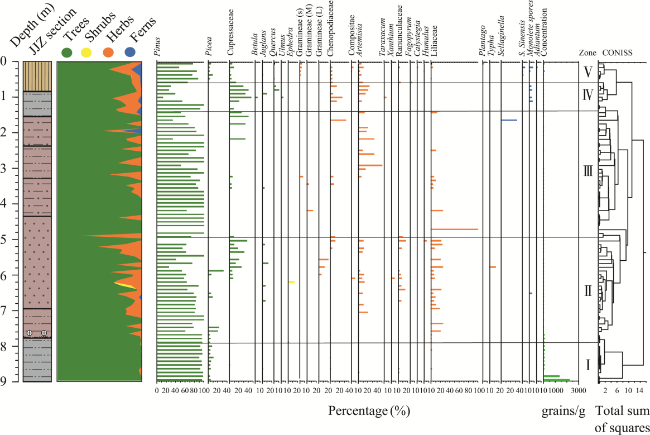
A total of 33 pollen types were identified in the 85 pollen samples: 10 tree taxa, 4 shrub taxa, 15 herb taxa, and 4 fern spore types. A total of 4730 pollen grains (excluding algae) were counted, with an average of 51 pollen grains per sample. The most common tree taxa were Pinus, Picea, Cupressaceae, Betula, Juglans, Quercus, and Ulmus; the most common shrub taxa were Ephedra; and the most common herb taxa were Artemisia, Liliaceae, Chenopodiaceae, Gramineae, Compositae, Taraxacum, Ranunculaceae, Fagopyrum, Calystegia, Typha, Plantago and Humulus. The Pteridophyte spores were mainly Selaginella, S. sinensis, Monolete, and Adiantum. The most common plant assemblage appeared to be Pinus + Cupressus + Chenopodiaceae + Artemisia + Liliaceae, suggesting a warm, humid temperate forest-grass environment. Applying a CONISS cluster analysis to the pollen percentage data indicated that the JJZ-B section could be divided into five pollen assemblage zones, as described below (Figure 3):
Figure 3 Pollen percentage diagram of the section at the JJZ site. The legend of JJZ section can be seen in Figure 1, the position of artifact legends in the lithology indicates the artifact layer.
Pollen Zone I (9.0-7.8 m): Equivalent to the LU of the section. The average pollen concentration was 316 grains/g, which is the highest concentration observed in the section. Tree pollen was predominant (average of 99.0%, range of 96.1%-100.0%), followed by herb pollen (1.0%, 0-3.9%), whereas shrub pollens were less common, and no fern pollen was identified. Pinus was the main tree pollen type (98.4%, 89.6%-97.5%), followed by Picea (4.0%, 0-9.7%); Cupressaceae (0.1%, 0-0.9%) and Juglans (0.1%, 0-0.8%) were less common. The herb taxa of Gramineae (0.1%, 0-0.5%), Chenopodiaceae (0.1%, 0-0.8%), Artemisia (0.1%, 0-1.3%), Ranunculaceae (0.2%, 0-1.6%) and Liliaceae (0.5%, 0-1.6%) were identified. This zone displays a cold and humid forest environment as indicated by the high proportions of Pinus and Picea species.
Pollen Zone II (7.8-5.0 m): Equivalent to the lower part of MU of the section. The average pollen concentration was only 1.3 grains/g, which was significantly low. Tree pollen was predominant (78.1%, 0-100%), followed by herb pollen (21.3%, 0-100%), whereas shrub pollen (0.4%, 0-12.5%) and fern pollen (0.2%, 0-4.5%) were less common. Pinus was the main tree pollen type (66.9%, 0-100%), followed by Picea (3.3%, 0-31.6%) and Cupressaceae (6.4%, 0-36.8%); Juglans (1.0%, 0-12.5%) and Eucommia (0.4%, 0-12.5%) were less common. Only Ephedra (0.4%, 0-12.5%) was identified as shrub pollen. Herb pollen was dominated by Liliaceae (11.7%, 0-100%), followed by Artemisia (3.6%, 0-20%) and Ranunculaceae (2.6%, 0-158%). A few monolete spores (0.2%, 0-4.5%) were identified as fern pollen. This zone reflected a cool and humid sparse forest grassland environment, as indicated by the high proportions of Pinus, Picea, Artemisia and Liliaceae species.
Pollen Zone III (5.0-1.8 m): Equivalent to the upper part of MU of the section. The average pollen concentration was only 0.8 grains/g, which is the lowest concentration in the entire section. Tree pollen was predominant (88.9%, 33.3%-100%), followed by herb pollen (10.1%, 0-50.0%). Fern pollen (1.0%, 0-33.3%) was less common, and no shrub pollen was identified. Pinus was the main tree pollen type (81.4%, 33.3%-100%), followed by Cupressaceae (4.7%, 0-34.0%), and Juglans (0.1%, 0-4.3%) was less common. Herb pollen was dominated by Artemisia (5.9%, 0-50.0%), followed by Liliaceae (2.1%, 0-25.0%) and Chenopodiaceae (1.4%, 0-33.3%). Sellaginella (1.0%, 0-33.3%) was identified as fern pollen. This zone had a cool and relatively dry sparse forest grassland environment, as indicated by the high proportions of Pinus, Artemisia, Chenopodiaceae in the landscape.
Pollen Zone IV (1.8-1.0 m): Equivalent to the UU of the section. The average pollen concentration was only 1.4 grains/g. Tree pollen was predominant (72.6%, 61.3%-81.0%), followed by herb pollen (25.4%, 19.0%-35.5%). Fern pollen (1.0%, 0-33.3%) was less common, and no shrub pollen was identified. Tree pollen was dominated by Pinus (37.2%, 12.5%-65.2%) and Cupressaceae (30.2%, 13.0%-45.8%), followed by Quercus (2.2%, 0-10.0%) and Juglans (1.6%, 0-9.5%). Herb pollen was dominated by Artemisia (12.0%, 0-22.6%) and Chenopodiaceae (10.01%, 0-25.0%), whereas Taraxacum (0.7%, 0-4.3%), Ranunculaceae (0.7%, 0-4.3%), and Fagopyrum (0.7%, 0-4.3%) were less common. Only monolete spores (3.2%, 0-6.7%) were identified as fern pollen. This zone reflected a temperate and relatively dry sparse forest grassland environment as indicated by the high proportions of Pinus, Cupressaceae, Artemisia and Chenopodiaceae in the landscape.
Pollen Zone V (1.0-0 m): Equivalent to the Loess Unit of the section. The average pollen concentration was 23.5 grains/g. Tree pollen was predominant (82.9%, 56.9%-93.8%), followed by herb pollen (3.5%, 0-13.8%), and shrub pollen (0.1%, 0-0.4%) was less common. Pinus was the main tree pollen type (73.6%, 46.6%-86.9%), followed by Cupressaceae (4.2%, 0.8%-8.6%), Picea (3.8%, 1.7%-8.3%) and Quercus (0.4%, 0-1.0%). Herb pollen was dominated by Artemisia (5.3%, 1.5%-10.3%), Chenopodiaceae (2.9%, 0-3.8%) and Gramineae (2.0%, 0-4.0%), followed by Liliaceae (1.0%, 0-3.4%). Monolete spores (1.6%, 0-6.9%), Sellaginella Sinensis (1.5%, 0-5.2%), and Adiantum (0.3%, 0-1.7%) were identified as fern pollen. This zone had a cool and relatively humid sparse forest grassland environment, as indicated by the high proportions of Pinus, Picea, Cupressaceae, Artemisia, and Chenopodiaceae in the landscape.

4.2 Grain-size results

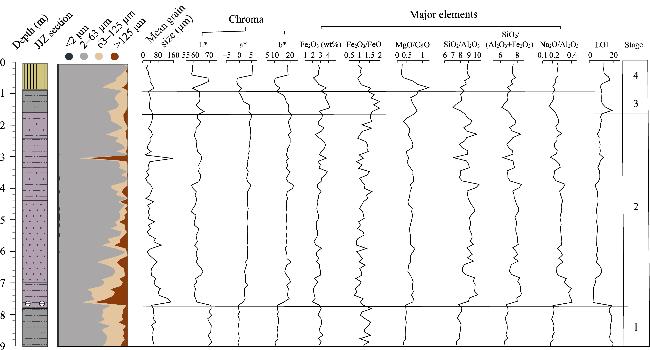
The lithology within the studied interval of the JJZ section was mainly gray, brown-yellow, and brown-gray silt and sand, containing mollusk fossils with horizontal, ripple and cross beddings. The grain size results demonstrated that silt (4-63 μm) was the dominant textural component (average of 75.20%), followed by fine sand (63-125 μm; 16.85%), and coarse sand (7.43%). The average median grain size was 48.27 μm and thus the sediments were relatively fine-grained. The sorting of the sediments was relatively poor with the sorting coefficient (σ) ranging from 1.09 to 2.20, with a mean value of 1.45. Skewness (SK1) ranged from -0.28 to 0.45, with a mean value of 0.17, showing characteristics of positive skewness. It is generally accepted that silty sediments are common in flood plains or lake margins, where they are deposited at lower flow speeds (Hassan, 1978). This indicates that the sedimentary matrix is primarily formed by fine-grained sediments, mainly silt, in the shallow lake margins. The grain size results were used to divide the studied interval into four stages (Figure 4).
Figure 4 Variation curve of grain size, color records, Fe2O3, and molar ratios of Fe2O3/FeO, MgO/CaO, SiO2/Al2O3, SiO2/(Al2O3+Fe2O3), Na2O/Al2O3 and LOI from the section at JJZ site. The legend of the JJZ section can be seen in Figure 1, the position of artifact legends in the lithology indicates the artifact layer.
Stage 1 (9.0-7.8 m): Equivalent to the LU of the section. The average median grain size (Md) was 55.06 μm (range of 46.02-67.84 μm). The average silt content was 65.53% (56.17%-73.31%), the lowest among the four zones, whereas the average fine sand content was 26.97% (23.45%-30.65%), which was the highest. The average coarse sand content was 7.28% (3.12%-13.60%), and the average clay content was 0.22% (0.12%-0.38%). In this stage, the water velocity was low, the lake level was relatively high and stable, and the lakeshore margin extended to land.
Stage 2 (7.8-1.8 m): Equivalent to the MU of the section. The average Md is 49.11 μm (12.55-126.50 μm). The average silt content was 76.92% (13.23%-98.68%), and the average fine sand content was 14.52% (0-34.12%). The average coarse sand content was 7.93% (0-67.41%), the highest among the four stages; and the average clay content was 0.63% (0.03%-1.68%). In this stage, the water velocity was relatively high and the lakeshore retreated from the lake. The dramatic curve fluctuated slightly, indicating that the water agency varied to some extent.
Stage 3 (1.8-1.0 m): Equivalent to the UU of the section. The average Md is 41.50 μm (31.03-58.64 μm), the finest within the studied interval. The average silt content was 79.16% (61.95%-89.64%), which was the highest component among the lake shore sequence. The average fine sand content was 18.89% (9.91%-29.03%); the average coarse sand content was 1.72% (0.01%-8.80%); and the average clay content was 0.23% (0.04%-0.43%). In this stage, the water velocity reduced and the lakeshore line extended to land.
Stage 4 (1.0-0.0 m): Equivalent to the Loess Unit of the section. The average Md was 27.02 μm (18.53-31.72 μm). The average silt content was 93.67% (90.44%-98.57%), and the average fine sand content was 5.13% (0.88%-9.37%). Sediments at this stage indicated the cessation of lake deposition.

4.3 Color and major geochemical elements results

The color records from lacustrine sediments suggested functional relationships between the soil formation process and climatic factors (Guo et al., 1998). L* (brightness) is positively correlated with carbonate content, and a higher L* value corresponds to a higher carbonate content and a cold climate, and vice versa (Li et al., 2018). a* value (red-green color) is correlated with the Mg content in the sediments. Higher a* values correspond to higher MgO content and higher MgO/CaO ratios in sediments, which reflect warmer and humid climates (Wu and Li, 2004). The b* value is positively correlated with Fe3+ content. A higher b* value represents sediments formed under oxidizing conditions. The b* value can indirectly reflect lake water depth change and efficient moisture change; higher b* values reflect low levels of the lake and a relatively warm and dry climate (Wu and Li, 2004; Li et al., 2018). The contrast of the color records in a sediment sample from the JJZ archaeostratigraphic sequence is presented in the Table 1.
Table 1 Contrast of color records of sedimentary samples from different units of the JJZ archaeostratigraphic sequence
Stratigraphic unit Range Mean
L* (Lightness) a* (Redness) b* (Yellowness) L* a* b*
Loess 58.16-59.33 6.02-6.31 18.46-18.79 58.93 6.15 18.60
Upper 59.07-69.93 -0.49-2.28 9.82-17.48 64.83 0.71 13.21
Middle 58.37-66.73 2.11-5.69 16.07-22.36 62.15 4.02 18.59
Lower 69.03-71.68 -0.04-0.58 10.03-12.76 70.60 0.24 11.83
All data 58.16-71.68 -0.49-6.31 9.82-2.36 63.54 3.28 17.05
All data excluded loess 58.37-71.68 -0.49-5.69 9.82-22.36 63.77 3.13 16.97
The major geochemical components of a sediment sample are usually presented as oxide percentages (Table 2). The combination of some oxides can provide robust information on weathering processes and environmental changes (Zhao et al., 2004; Yang et al., 2016; Han et al., 2019). We used the change in the proportion of Fe2O3 and the ratios of Fe2O3/FeO and MgO/CaO as environmental indicators. Fe2O3 is formed in an oxidizing environment with relatively turbulent water, which can absorb more oxygen, whereas FeO is formed in a deoxidized environment with relatively calm water (Schwertmann, 1973, 1985; Li et al., 2016). A high ratio of Fe2O3/FeO reflects a warmer and drier climate. MgO is formed in high-temperature oxidizing environments, and a higher MgO/CaO ratio reflects warmer climatic conditions. SiO2 is a stable chemical element that can be used as an indicator of weathering intensity. Higher SiO2/Al2O3 and SiO2/(Al2O3+Fe2O3) ratios reflect relatively strong weathering intensity and warmer climatic conditions (Sheldon and Tabor, 2009; Hao et al., 2010). Na is one of the most mobile elements, the Na2O/Al2O3 ratio can also be used as one indicator of weathering intensity (Gu et al., 1999; Ding et al., 2001). Lower Na2O/Al2O3 reflect lower maturity of clastic material in source regions and lower post-depositional weathering intensity which indicate cold climate condition (Yang et al., 2006). The LOI obtained by weighing samples before and after 2 h of heating at 1000°C in this study was positive correlated with carbonate content. A higher LOI value reflects cold climatic conditions (Dean, 1974; Liu et al., 2006).
Table 2 Mean concentrations (wt.%) of major geochemical elements of sedimentary samples from different units of the JJZ archaeostratigraphic sequence
Stratigraphic unit SiO2 Al2O3 Fe2O3 FeO MgO CaO K2O N2O TiO2 P2O5 LOI
Loess 55.64 11.29 2.86 1.37 2.41 9.99 2.11 1.76 0.60 0.11 11.66
Upper 56.41 12.25 3.29 1.18 3.45 6.99 2.42 1.64 0.61 0.12 11.51
Middle 62.71 12.62 2.93 1.26 2.25 5.04 2.69 2.12 0.63 0.14 7.46
Lower 45.15 10.51 3.06 1.18 4.40 13.61 2.18 1.31 0.52 0.15 17.76
All data 59.10 12.20 2.98 1.24 2.70 6.77 2.56 1.94 0.61 0.14 9.62
All data excluded loess 59.27 12.25 2.98 1.24 2.71 6.61 2.56 1.95 0.61 0.14 9.51
Combined with the major geochemical elements and color records from different units of the JJZ sequence, four evolutionary stages (Figure 4) can be classified as follows:
Stage 1: Corresponds to the LU. The L* content ranged from 61.03 to 71.68, with an average of 70.60. The average content of LOI was 17.76%, which was the highest among the four stages, reflecting a relatively high content of carbonate and a cold climate. The a* content ranged from -0.04 to 0.58 with an average of 0.24, which was the lowest among the four stages. The average content of MgO was 4.40%, which was the highest among the four stages, but the MgO/CaO spanned 0.39%-0.48%, with an average of 0.45, which was the lowest among the four stages, indicating relatively low temperature. The b* content spanned 10.03-12.76, with an average of 11.83, which was also the lowest among the four stages. The Fe2O3/FeO ratio was between 0.92-1.44, with an average of 1.18, indicating a relatively low value, which reflected the relatively higher water level of the lake and weaker oxidizing conditions. The average SiO2/Al2O3, SiO2/(Al2O3+Fe2O3) and Na2O ratios were 7.29, 6.07 and 0.21, respectively, which were the lowest in the sequence, indicating a relatively low intensity of weathering and relatively cold climatic condition. The LU of the sediments was dominated by silty clay and weak weathering processes, indicating a relatively weak deoxidizing environment resulting from cold and moist climatic conditions.
Stage 2: Corresponds to the MU. The L* content ranged from 58.37 to 66.73, with an average of 62.15, which was lower than that of Stage 1. The average content of LOI had the lowest value of 7.46% in the whole sequence, reflecting a change to warmer climate conditions. The a* content ranged from 2.11 to 5.69, with an average of 4.02, which was the highest in the lacustrine sequence. The average content of MgO was 2.25%, which was the lowest among the four stages. However, the MgO/CaO ratio was between 0.39-0.83, with an average of 0.63, which was higher than that of Stage 1, indicating an increase in temperature. The b* content was between 16.07-22.36, with an average of 18.59, which was the highest in the lacustrine sequence. The Fe2O3/FeO ratio spanned 0.6-1.80, with an average of 1.07, a relatively low value indicating a decrease in the level of the lake, leading to stronger oxidizing conditions. The average SiO2/Al2O3, SiO2/(Al2O3+Fe2O3), and Na2O/ Al2O3 ratios were 8.45, 7.29 and 0.28, respectively, which were the highest in the sequence, indicating relatively strong intensity of weathering and warmer climatic condition. The MU of the sediment unit was dominated by sand and strong weathering processes, indicating a relatively strong oxidizing environment resulting from warmer and dry climatic conditions.
Stage 3: Corresponds to the UU. The L* content was between 59.07-69.93, with an average of 64.83, and the average content of LOI was 11.51%, higher than that of Stage 2 and indicating a temperature decrease. The a* content spanned from -0.49 to 2.28, with an average of 0.71, which was lower than that of Stage 2. The average content of MgO was 3.45%, which was lower than that of stage 2, and the MgO/CaO ratio was between 0.38-1.21, with an average of 0.76, which was the highest among the four stages, indicating an increase in the temperature. The b* content was between 9.82-17.48, with an average of 13.21, which was lower than that of Stage 2. The Fe2O3/FeO ratio spanned 0.84-1.80, with an average of 1.27, which was the highest among the four stages, indicating that the lake water level rose and the temperature decreased. The average SiO2/Al2O3, SiO2/(Al2O3+Fe2O3), and Na2O ratios were 7.85, 6.64, and 0.22, respectively, which were lower than that of Stage 2, indicating a decrease in the weathering intensity and temperature decreased. The UU sediment unit was dominated by silt and weak weathering processes, indicating a weaker oxidizing environment resulting from the relatively warm and moist climatic conditions.
Stage 4: Corresponds to the Loess Unit. The L* content was between 58.16-59.33, with an average of 58.93, which was the lowest among four stages. The a* content spanned 6.02-6.31, with an average of 6.15, which was the highest among the four stages. The average content of MgO was 2.41%, which was lower than that of Stage 3, and the MgO/CaO ratio was between 0.32-0.35, with an average of 0.34, which was the lowest among the four stages, indicating a decrease in temperature. The b* content spanned from 18.46 to -18.79, with an average of 18.60, which was the highest among the four stages. The Fe2O3/FeO ratio was between 0.82-1.01, with an average of 0.94, which was the lowest among the four stages. The average SiO2/Al2O3, SiO2/(Al2O3+Fe2O3), and Na2O/Al2O3 ratios were 8.36, 7.11, and 0.26, respectively, which were higher than those of Stage 3, indicating a relatively strong intensity of weathering and the temperature increased. The Loess Unit of the sediments was dominated of silt and strong weathering processes, indicating a relatively strong oxidizing environment resulting from warmer and drier climatic conditions.

5 Discussion and conclusions

Recent study indicates that Middle Pleistocene Climate Transition (1.25-0.7 Ma) witnessed increased climate amplitude and aridity fluctuations and led to the widespread formation of more open habitats and desert-loess landscapes in Palearctic Eurasia (Yang et al., 2006; Zan et al., 2024), pushing hominins to range more widely and find solutions to increasingly challenging environments. Subsequently, the Mid-Pleistocene climatic and ecological transitions, and the formation of desert and loess landscapes and river networks, emerge as critical events during the dispersal of early humans in middle to high latitude in East Asia (Wang et al., 2024; Zan et al., 2024). It is generally accepted that the extra-long moist and warm interglacials (MISs 15-13, 621-478 ka) created a “window of opportunity” for hominin evolution and behavioral adaptations within Mid-Pleistocene (Hao et al., 2015; Dennell et al., 2020), in which a denser and/or a re-colonization of the Nihewan Basin may have taken place, as shown by the recent investigation at JJZ archaeological site (Pei et al., 2018; Du et al., 2023; Ye et al., 2023; 2024).
Given that the long-term high-resolution paleoclimate records directly retrieved from the Middle Pleistocene Nihewan sedimentary sequence are scarce, recent studies of pollen and isotope records from a wider region provide data for exploring early human adaptability in the Early to Middle Pleistocene Nihewan Basin. During the interval of 0.8-0.3 Ma, the pollen assemblages of the Nihewan Haojiatai A (NHA) drill core were dominated by herbaceous pollen (> 60%), indicating that the vegetation in the study area was mainly forest steppe (Da et al., 2023). Furthermore, a systematic pollen analysis of fossil and surface samples indicated that the interval of 0.742-0.478 Ma was a pronounced warm and wet period in the Nihewan Basin. This corresponded well with MIS 13 and might have been related to the unusually strong summer monsoon caused by the climatic asymmetry in the Northern Hemisphere (Da et al., 2023). This might have resulted in the formation of an interglacial lakeshore landscape of the Middle Pleistocene Nihewan Basin, which offers a variety of aquatic and terrestrial plants and animals, and produces concentrated areas of high biodiversity in a challenging landscape.
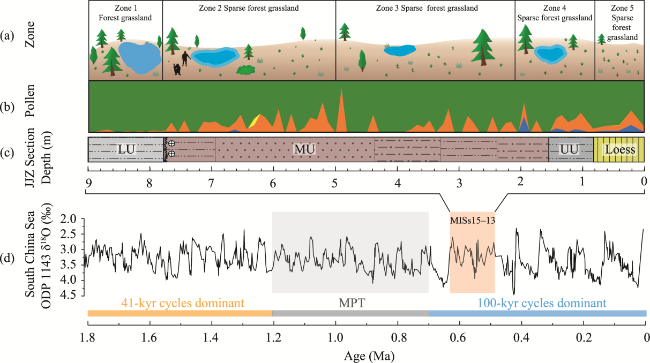
In this study, proxy climatic indicators, including pollen, sediment grain size, color reflectance, and major geochemical element analysis, were used to identify five zones of environmental variability during JJZ site formation (Figure 5). In the Zone I (LU), the climate was cold and humid with a forest grassland environment, and the water level was relatively high. No archaeological remains were discovered, indicating that hominins did not occupy the site. In Zone II (lower part of MU), the lake water level decreased and the climate became temperate and dry with sparse forest grassland lakeshore habitat. A total of 255 lithic artifacts and 464 fossil fragments were unearthed, indicating that most hominin activities occurred during this episode. In Zone III (upper part of MU), the climate became relatively cool and dry, with a lightly wooded grassland habitat. No archaeological remains were discovered, indicating that hominins did not occupy this site. In Zone IV (UU), the water level of the lake increased and the climate became warmer and moist, with a sparse forest grassland. No evidence indicated the presence of hominins, although they may have been presented at other sites in the Nihewan Basin (Wang and Sun, 2023). In Zone V (Loess Unit), when the Nihewan paleolake dried up, the climate changed to a cool and relatively drier sparse forest grassland environment.
Figure 5 Synthesis of ecological and landscape history of the JJZ site in the Nihewan Basin. (a) Hypothetical setting of JJZ archaeological landscape. (b) Pollen results of the JJZ archaeostratigraphic sequence (different colors represent different vegetation types as shown in Figure 3). (c) Lithology of JJZ archaeostratigraphic sequence (different colors represent different units as shown in Figure 1). (d) δ18O record from ODP Site 1143, South China Sea (Tian et al., 2002).
Current evidence shows that, during the occupational event of hominins in the JJZ, the lakeshore setting may have played a role in the affordances available to hominins to adjust their adapted strategies. For raw material procurement, the JJZ hominins transported exotically diverse stone raw materials over 8-10 km, which contrasts with the strategy of Early Pleistocene hominins collecting cherts near those sites (Pei and Hou, 2002; Pei et al., 2017). This long-distance transportation strategy adopted by the JJZ hominins confirms wider resource procurement, indicating a novel approach to landscape exploitation than start in the Early Pleistocene. In addition, the JJZ lithic technologies displayed innovative technological strategies, such as the desired end products being predominantly small to medium-sized flakes (≤ 4 cm average length), and the production of a variety of elaborate tool types (e.g. denticulates, borers, and pointed tools; Ye et al., 2024) (Figures 2a-2c). Such refined tool may be used for acquiring and consuming animal tissues (Conard and Prindiville 2000; Roebroeks, 2006; Stiner, 2013), as demonstrated by the current research on JJZ animal fossils (Du et al., 2023). The presence of cut marks indicates a variety of human activities, such as skinning, dismembering, and defleshing; whereas percussion traces on the bone surface suggest marrow extraction strategies (Du et al., 2023) (Figure 2d). It is reasonable to hypothesize that the JJZ lake shore landscape was an optimal environment for human subsistence activities, such as procurement, butchering, and marrow extraction of large-sized herbivores that were attracted to this area for water and variety of aquatic and terrestrial plants. Therefore, the consumption of animal resources may have significantly enhanced early human’s adaptability to environmental changes, leading to the geographic range expansion in the diverse ecological settings of North China and persistence in the Nihewan Basin during the extra-long duration of interglacial or mild stadial climate events (MISs 15-13) within Middle Pleistocene.

Conflicts of interest

The authors declare no conflict of interest.

We would like to thank Professor GE Junyi from the IVPP for his valuable conversations. We are grateful to Professors WANG Yong and GUO Caiqing from the Institute of Geology (Chinese Academy of Geological Sciences, CAGS) for the fruitful discussions on the explanation of proxy parameters. Grain size, color, and pollen measurements were performed in the Laboratory of Quaternary Environment, Institute of Geology, CAGS, and the measurements of major geochemical elements were carried out at the Beijing Research Institute of Uranium Geology (CNNC). We take full responsibility for any potential errors that may be present.

[1]
Abbate E, Sagri M, 2012. Early to Middle Pleistocene Homo dispersals from Africa to Eurasia: Geological, climatic and environmental constraints. Quaternary International, 267: 3-19.

[2]
Ao H, Dekkers M J, An Z S et al., 2013. Magnetostratigraphic evidence of a mid-Pliocene onset of the Nihewan Formation implications for early fauna and hominid occupation in the Nihewan Basin, North China. Quaternary Science Reviews, 59: 30-42.

[3]
Ao H, Liu C R, Roberts A P et al., 2017. An updated age for the Xujiayao hominin from the Nihewan Basin, North China: Implications for Middle Pleistocene human evolution in East Asia. Journal of Human Evolution, 106: 54-65.

DOI PMID

[4]
Ao H, Rohling E J, Stringer C et al., 2020. Two-stage mid-Brunhes climate transition and mid-Pleistocene human diversification. Earth Science Reviews, 210: 103354.

[5]
Athreya S, Wu X, 2017. A multivariate assessment of the Dali hominin cranium from China: Morphological affinities and implications for Pleistocene evolution in East Asia. American Journal of Physical Anthropology, 164: 679-701.

DOI PMID

[6]
Bae C J, 2010. The late Middle Pleistocene hominin fossil record of eastern Asia: Synthesis and review. American Journal of Physical Anthropology, 143(S51): 75-93.

[7]
Bae C J, Li F, Cheng L L et al., 2018. Hominin distribution and density patterns in Pleistocene China: Climatic influences. Palaeogeography, Palaeoclimatology, Palaeoecology, 512: 118-131.

[8]
Bae C J, Liu W, Wu X J et al., 2023. “Dragon man” prompts rethinking of Middle Pleistocene hominin systematics in Asia. The Innovation, 4(6): 100527.

[9]
Chen M N, 1988. Study on the Nihewan Beds. Beijing: China Ocean Press. (in Chinese)

[10]
Conard N J, Prindiville T J, 2000. Middle Palaeolithic hunting economies in the Rhineland. International Journal of Osteoarchology, 10: 286-309.

[11]
Da S Q, Zhang Z, Li Y C et al., 2023. Pollen-based quantitative paleoclimatic record spanning the Mid-Brunhes Event in the Nihewan Basin, north China. Palaeogeography, Palaeoclimatology, Palaeoecology, 612: 111377.

[12]
Dean W E, 1974. Determination of carbonate and organic matter in calcareous sediments and sedimentary rocks by loss on ignition: Comparison with other methods. Journal of Sedimentary Research, 44(1): 242-248.

[13]
Deng C L, Hao Q Z, Guo Z T et al., 2019. Quaternary integrative stratigraphy and timescale of China. Science China, Earth Science, 62(1): 324-348.

[14]
Deng C L, Zhu R X, Zhang R et al., 2008. Timing the Nihewan formation and faunas. Quaternary Research, 69(1): 77-90.

[15]
Dennell R W, Martinón-Torres M, Bermudez de Castro J M et al. 2020. A demographic history of late Pleistocene China. Quaternary International, 559: 4-13.

[16]
Ding Z L, Sun J M, Yang S L et al., 2001. Geochemistry of the Pliocene red clay formation in the Chinese Loess Plateau and implications for its origin, source provenance and paleoclimate change. Geochimica et Cosmochimica Acta, 65: 901-913.

[17]
Du Y W, Zhang Y, Ye Z et al., 2023. A taphonomic analysis of faunal remains from the Jijiazhuang Paleolithic site in the Yuxian Basin. Acta Anthropologica Sinica, 42(3): 359-372. (in Chinese)

[18]
Erdtman G, 1960. The acetolysis method. A revised description. Svensk Botanisk Tidskrift, 54: 561-564.

[19]
Grove M, 2014. Evolution and dispersal under climatic instability: A simple evolutionary algorithm. Adaptive Behavior, 22(4): 235-254.

[20]
Grove M, 2017. Environmental complexity, life history, and encephalisation in human evolution. Biology & Philosophy, 32(3): 395-420.

[21]
Gu Z Y, Ding Z L, Xiong S F et al., 1999. A seven million geochemical record from Chinese red-clay and loess-paleosol sequence: Weathering and erosion in northwestern China. Quaternary Sciences, 4: 357-365. (in Chinese)

[22]
Guo Y J, Li B, Zhang J F et al., 2016. Luminescence ages for three ‘Middle Palaeolithic’ sites in the Nihewan Basin, northern China, and their archaeological and palaeoenvironmental implications. Quaternary Research, 85(3): 456-470.

[23]
Guo Z T, Liu T S, Fedoroff N, et al., 1998. Climate extremes in loess of China coupled with the strength of deep-water formation in the North Atlantic. Global and Planetary Change, 18: 113-128.

[24]
Han L, Hao Q Z, Qiao Y S, et al., 2019. Geochemical evidence for provenance diversity of loess in southern China and its implications for glacial aridification of the northern subtropical region. Quaternary Science Reviews, 212: 149-163.

[25]
Hao Q Z, Guo Z T, Qiao Y S et al., 2010. Geochemical evidence for the provenance of middle Pleistocene loess deposits in southern China. Quaternary Science Reviews, 29: 3317-3326.

[26]
Hao Q Z, Wang L, Oldfield F et al. 2015. Extra-long interglacial in Northern Hemisphere during MISs 15-13 arising from limited extent of Arctic ice sheets in glacial MIS 14. Scientific Reports, 5: 12103.

DOI PMID

[27]
Hassan F A, 1978. Sediments in archaeology: methods and implications for paleoenvironmental and cultural analysis. Journal of Field Archaeology, 5: 197-213.

[28]
Li X L, Pei S W, Jia Z X et al., 2016. Paleoenvironmental conditions at Madigou (MDG), a newly discovered Early Paleolithic site in the Nihewan Basin, North China. Quaternary International, 400: 100-110.

[29]
Li X Q, Du N Q, 1999. The acid-alkali-free analysis of Quaternary pollen. Acta Botanica Sinica, 41: 782-784. (in Chinese)

[30]
Li Y, Fang J, Pan L et al., 2018. Application of sediment chromaticity in paleo-environment reconstruction. Advances in Meteorological Science and Technology, 8(6): 2-27. (in Chinese)

[31]
Liu W, Athreya S, Xing S et al., 2022. Hominin evolution and diversity: A comparison of earlier-Middle and later-Middle Pleistocene hominin fossil variation in China. Philosophical Transactions of the Royal Society B, 377: 20210040.

[32]
Liu W, Martinón-Torres M, Kaifu Y et al., 2017. A mandible from the Middle Pleistocene Hexian site and its significance in relation to the variability of Asian Homo erectus. American Journal of Physical Anthropology, 162: 715-731.

DOI PMID

[33]
Liu W, Wu X J, Xing S, 2019. The morphological evidence for the regional continuity and diversity of Middle Pleistocene human evolution in China. Acta Anthropologica Sinica, 38(4): 473-490. (in Chinese)

[34]
Liu Z T, Yu J Q, Zhang B H, 2006. Application of loss on ignition to the study of lake sediments and environmental changes. Journal of Salt Lake Research, 14(2): 67-72. (in Chinese)

[35]
Lu H Y, An Z S, 1998. Pretreated methods on loess-palaeosol samples granulometry. Chinese Science Bulletin, 43: 237-240.

[36]
Ma D D, Niu D W, Pei S W et al., 2021. A preliminary report on the Paleolithic survey of 2017-2018 in Yuxian Basin. Acta Anthropologica Sinica, 40(1): 128-136. (in Chinese)

[37]
Moore P D, Webb J A, 1978. An Illustrated Guide to Pollen Analysis. London: Hodder and Stoughton.

[38]
Peck R M, 1974. A comparison of four absolute pollen preparation techniques. New Phytologist, 73: 567-587.

[39]
Pei S W, 2017. Discovery of an important site complex of early hominins in the southeast part of the Nihewan Basin (Yuxian basin). Acta Anthropologica Sinica, 36(1): 26. (in Chinese)

[40]
Pei S W, Deng C L, de la Torre I et al., 2019. Magnetostratigraphic and archaeological records at the Early Pleistocene site complex of Madigou (Nihewan Basin): Implications for human adaptations in North China. Palaeogeography, Palaeoclimatology, Palaeoecology, 530: 176-189.

[41]
Pei S W, Hou Y M, 2002. Preliminary study on raw materials exploitation at Donggutuo site, Nihewan Basin, North China. Acta Anthropologica Sinica, 21(Suppl.): 53-66.

[42]
Pei S W, Li X L, Liu D C et al., 2009. Preliminary study on the living environment of hominids at the Donggutuo site, Nihewan Basin. Chinese Science Bulletin, 54: 3896-3904.

[43]
Pei S W, Ma D D, Jia Z X et al., 2018. A preliminary report on excavation of the Jijiahuang Paleolithic site in the Yuxian Basin, North China. Acta Anthropologica Sinica, 37(4), 510-528. (in Chinese)

[44]
Pei S W, Xie F, Deng C L et al., 2017. Early Pleistocene archaeological occurrences at the Feiliang site, and the archaeology of human origins in the Nihewan Basin, North China. PLoS One, 12 (11): e0187251.

[45]
Potts R, 1996. Evolution and climate variability. Science, 273: 922-923.

[46]
Potts R, 1998. Variability selection in hominid evolution. Evolutionary Anthropology, 7: 81-96.

[47]
Potts R, Behrensmeyer A K, Faith J T et al., 2018. Environmental dynamics during the onset of the Middle Stone Age in eastern Africa. Science, 360: 86-90.

DOI PMID

[48]
Qin Z, Sun X F, 2023. Glacial-interglacial cycles and early human evolution in China. Land, 12: 1683.

[49]
Roebroeks W, 2006. The human colonisation of Europe: Where are we? Journal of Quaternary Science, 21: 425-435.

[50]
Sandweiss D H, Kelley A R, 2012. Archaeological contributions to climate change research: The archaeological record as a paleoclimatic and paleoenvironmental archive. Annual Review of Anthropology, 41: 371-391.

[51]
Schwertmann U, 1973. Use of oxalate for Fe extraction from soils. Canadian Journal of Soil Science 53: 244-246.

[52]
Schwertmann U, 1985. The effect of pedogenic environments on iron oxide minerals. In: Stewart D A (ed.). Advance in Soil Science, Vol. 1. New York: Springer-Verlag, 171-200.

[53]
Sheldon N D, Tabor N J, 2009. Quantitative paleoenvironmental and paleoclimatic reconstruction using paleosols. Earth Science Reviews, 95: 1-52.

[54]
Stiner M C, 2013. An unshakable Middle Paleolithic? Current Anthropology, 54(S8): S288-S304.

[55]
Sun X F, Lu H Y, Wang S J et al., 2017. Early human settlements in the southern Qinling Mountains, central China. Quaternary Science Reviews, 164:168-186.

[56]
Sun X F, Lu H Y, Wang S J et al., 2018. Hominin distribution in glacial-interglacial environmental changes in the Qinling Mountains range, central China. Quaternary Science Reviews, 198: 37-55.

[57]
Tang R P, Ge J Y, Pang H J et al., 2020. Paleohydro-climatic changes revealed by anisotropy of magnetic susceptibility at the Heitugou section, Nihewan Basin, and its influences on human’s occupation. Chinese Science Bulletin, 65(11): 1027-1045. (in Chinese)

[58]
Tang Y J, Ji H X, 1983. A Pliocene- Pleistocene transitional fauna from Yuxian, northern Hebei. Vertebrata Palasiatica, 21(3): 245-254. (in Chinese)

[59]
Tian J, Wang P X, Cheng X R et al., 2002. Astronomically tuned Plio-Pleistocene benthic δ18O record from South China Sea and Atlantic-Pacific comparison. Earth and Planetary Science Letters, 203(3/4): 1015-1029.

[60]
Wang F G, Sun Y C, 2023. Illustrated Encyclopedia of Nihewan. Shijiazhuang: Hebei Arts Publishing House, 1-516. (in Chinese)

[61]
Wang F X, Qian N F, Zhang Y L et al., 1997. Pollen Flora of China. 2nd ed. Beijing: Science Press, 1-461. (in Chinese)

[62]
Wang H, Li H, Qiu Y H et al. 2024. Seasonal landscape variability advances Lantian hominin’s recognition capacity to strategically adapt to changing environments. Quaternary Science Reviews, 336: 108786.

[63]
Wei Q, 2016. Examination on the Nihewan Basin. Wenwu Chunqiu, 2: 3-11. (in Chinese)

[64]
Wu X J, Crevecoeur I, Liu W et al., 2014. Temporal labyrinths of eastern Eurasian Pleistocene humans. PNAS, 111: 10509-10513.

[65]
Wu X J, Pei S W, Cai Y J et al., 2019. Archaic human remains from Hualongdong, China, and Middle Pleistocene human continuity and variation. PNAS, 116: 9820-9824.

[66]
Wu Y H, Li S J, 2004. Significance of lake sediment color for short time scale climate variation. Advances in Earth Science, 19(5): 789-792. (in Chinese)

DOI

[67]
Xi Y Z, Ning J C, 1994. Study on pollen morphology of plants from dry and semidry area in China. Yushania, 11: 119-191. (in Chinese)

[68]
Xia Z K, Liu X Q, 1984. On the paleogeography of the Nihewan Basin during the accumulation of the Nihewan Beds. Margin Geology & Quaternary Geology, 4(3): 101-110. (in Chinese)

[69]
Xing S, Martinón-Torres M, de Castro J M B, 2018. The fossil teeth of the Peking Man. Scientific Reports, 8: 1-11.

[70]
Xing S, Sun C, Martinón-Torres M et al., 2016. Hominin teeth from the Middle Pleistocene site of Yiyuan, eastern China. Journal of Human Evolution, 95: 33-54.

DOI PMID

[71]
Xu Z, Pei S W, Hu Y W et al., 2021. Stable isotope analysis of mammalian enamel from the Early Pleistocene site of Madigou, Nihewan Basin: Implications for reconstructing hominin paleoenvironmental adaptations in North China. Frontiers in Earth Science, 9: 789781.

[72]
Xu Z, Pei S W, Hu Y W et al., 2023. Ecological shifts and hominin adaptations during the Mid-Pleistocene Climate Transition in Northeast Asia as evidenced by isotopic analysis (δ13C, δ18O) of mammalian enamel from Early Paleolithic sites in the Nihewan Basin, China. Quaternary Science Reviews, 308: 108072.

[73]
Yang L, Sun Y J, Chong-Yi E et al., 2016. Geochemical element characteristics and paleoenvironmental significance of aeolian sediments in JXG 1 section. Journal of Salt Lake Research, 24(1): 44-53. (in Chinese)

[74]
Yang S L, Ding F, Dong Z L, 2006. Pleistocene chemical weathering history of Asian arid and semi-arid regions recorded in loess deposits of China and Tajikistan. Geochimica et Cosmochimica Acta, 70: 1695-1709.

[75]
Yang S X, Deng C L, Zhu R X et al., 2020. The Paleolithic in the Nihewan Basin, China: Evolutionary history of an early to late Pleistocene record in eastern Asia. Evolutionary Anthropology, 29(3): 125-142.

[76]
Yang S X, Pei S W, Deng C L, 2021. Human evolution of the Early and Middle Pleistocene in China and its relationship with climatic conditions. Acta Anthropologica Sinica, 40(3): 436-453. (in Chinese)

[77]
Ye Z, Du Y W, Pei S W et al., 2023. A study of the formation process of Jijiazhuang Paleolithic site in Yuxian Basin. Acta Anthropologica Sinica, 42(1): 46-60. (in Chinese)

[78]
Ye Z, Pei S W, Tu H et al., 2024. 26Al/10Be burial dating and technological strategies of hominins at the Jijiazhuang Paleolithic site, Nihewan Basin, China: Implications for understanding Middle Pleistocene human adaptations in East Asia. Quaternary Science Reviews, 339: 108837.

[79]
Yuan B Y, Tong H W, Wen R L et al., 2009. The formation mechanism of the Nihewan paleo-lake and its relationship with living environment for early ancient human. Journal of Geomechanics, 15(1): 77-87. (in Chinese)

[80]
Yuan B Y, Xia Z K, Niu P S, 2011. Nihewan Rift Valley and Paleoanthropology. Beijing: Geological Publishing House, 1-257. (in Chinese)

[81]
Zan J B, Louys J L, Dennell R et al. 2024. Mid-Pleistocene aridity and landscape shifts promoted Palearctic hominin dispersals. Nature Communications, 15: 10279.

[82]
Zhao H, Lu Y, Wang C et al., 2010. ReOSL dating of aeolian and fluvial sediments from Nihewan Basin, northern China and its environmental application. Quaternary Geochronology, 5(2-3): 159-163.

[83]
Zhao J H, Wang D, Fan B S et al., 2004. Geochemical characteristics of the loess deposit at Yan’an and its implication to changes of East Asia summer monsoon during the past 130 ka. Geochimica, 33(5): 495-500. (in Chinese)

[84]
Zhou T R, Li H Z, Liu Q S et al., 1991. Study on the Cenozoic Paleogeograpgy of Nihewan Basin. Beijing: Science Press, 1-162. (in Chinese)

[85]
Zhu R X, Deng C L, Pan Y X, 2007. Magnetochronology of the fluvio-lacustrine sequences in the Nihewan Basin and its implications for early human colonization of Northeast Asia. Quaternary Sciences, 27(6): 922-944. (in Chinese)

[86]
Zhu R X, Potts R, Xie F et al., 2004. New evidence on the earliest human presence at high northern latitudes in Northeast Asia. Nature, 431: 559-562.

Outlines

/