Journal of Geographical Sciences >
Spatio-temporal patterns of temperature extremes and their response to atmospheric circulation factors in China from 1961 to 2020
|
Luo Yuanbo (1991−), PhD Candidate, specialized in spatio-temporal data mining. E-mail: lybnju@163.com |
Received date: 2024-05-11
Accepted date: 2024-08-02
Online published: 2024-10-10
Supported by
National Key Research and Development Program of China(2021YFB3900900)
Changes in surface temperature extremes have become a global concern. Based on the daily lowest temperature (TN) and daily highest temperature (TX) data from 2138 weather stations in China from 1961 to 2020, we calculated 14 extreme temperature indices to analyze the characteristics of extreme temperature events. The widespread changes observed in all extreme temperature indices suggest that China experienced significant warming during this period. Specifically, the cold extreme indices, such as cold nights, cold days, frost days, icing days, and the cold spell duration index, decreased significantly by −6.64, −2.67, −2.96, −0.97, and −1.01 days/decade, respectively. In contrast, we observed significant increases in warm extreme indices. The number of warm nights, warm days, summer days, tropical nights, and warm spell duration index increased by 8.44, 5.18, 2.81, 2.50, and 1.66 d/decade, respectively. In addition, the lowest TN, highest TN, lowest TX, and highest TX over the entire period rose by 0.47, 0.22, 0.26, and 0.16°C/decade, respectively. Furthermore, using Pearson’s correlation and wavelet coherence analyses, this study identified a strong association between extreme temperature indices and atmospheric circulation factors, with varying correlation strengths and resonance periods across different time-frequency domains.
LUO Yuanbo , ZHOU Yuke , ZHOU Chenghu . Spatio-temporal patterns of temperature extremes and their response to atmospheric circulation factors in China from 1961 to 2020[J]. Journal of Geographical Sciences, 2024 , 34(10) : 1883 -1903 . DOI: 10.1007/s11442-024-2275-2
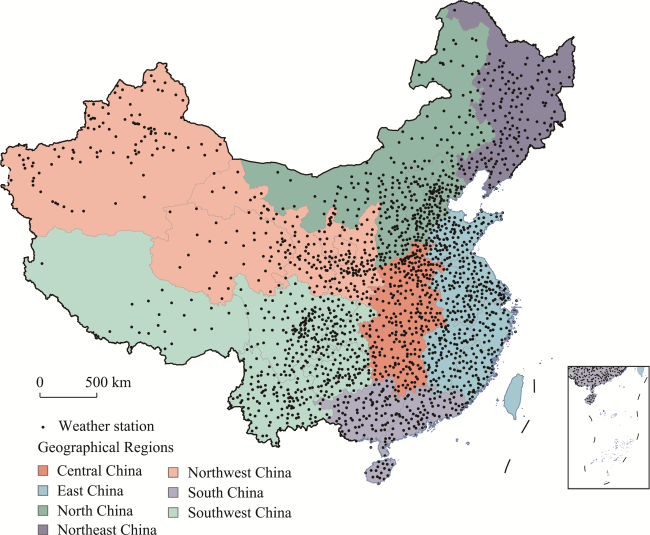
Figure 1 Geographical distribution of the 2138 weather observatories with observations ranging from 1961 to 2020 used in this study across China. The seven geographical divisions in China include North China (NC), East China (EC), Central China (CC), South China (SC), Northwest China (NWC), Southwest China (SWC), and Northeast China (NEC) |
Table 1 Definitions of 14 extreme temperature indicators. TX represents the highest temperature recorded each day, while TN represents the lowest temperature recorded each day. |
| Index | Descriptive name | Definition | Units |
|---|---|---|---|
| Absolute indices | |||
| TXx | Highest TX | Monthly highest value of TX records | °C |
| TXn | Lowest TX | Monthly lowest value of TX records | °C |
| TNx | Highest TN | Monthly highest value of TN records | °C |
| TNn | Lowest TN | Monthly lowest value of TN records | °C |
| Percentile-based indices | |||
| TN10p | Cold nights frequency | The proportion of days during the baseline period when TN is lower than the 10th percentile | % |
| TX10p | Cold days frequency | The proportion of days during the baseline period when TX is lower than the 10th percentile | % |
| TN90p | Warm nights frequency | The proportion of days during the baseline period when TN is higher than the 90th percentile | % |
| TX90p | Warm days frequency | The proportion of days during the baseline period when TX is higher than the 90th percentile | % |
| Other indices | |||
| SU | Number of summer days | Days annually when TX is higher than 25°C | days |
| TR | Number of tropical nights | Days annually when TN is higher than 20°C | days |
| FD | Number of frost days | Days annually when TN is lower than 0°C | days |
| ID | Number of icing days | Days annually when TX is lower than 0°C | days |
| WSDI | Warm spell duration index | Days annually with a minimum of six successive days when TX is higher than the 90th percentile | days |
| CSDI | Cold spell duration index | Days annually with a minimum of six successive days when TN is lower than the 90th percentile | days |
Figure 2 Annual anomaly series of temperature index over China from 1961 to 2020 relative to the 1971-2000 mean. The black dotted line depicts the outcomes of the linear regression analysis, whereas the red solid line illustrates the 5-year moving average. |
Table 2 Proportion of stations with upward (+ve) and downward (-ve) trends in the extreme temperature indicator at the 5% significance level in China from 1961 to 2020, calculated using the Mann-Kendall test. |
| Indicator | +ve Significant trend | -ve Significant trend | Indicator | +ve Significant trend | -ve Significant trend |
|---|---|---|---|---|---|
| TXx | 861 (40.2%) | 25 (1.2%) | TX90p | 1808 (84.5%) | 4 (0.2%) |
| TXn | 661 (30.9%) | 4 (0.2%) | SU | 1744 (81.5%) | 9 (0.4%) |
| TNx | 1636 (76.4%) | 17 (0.8%) | TR | 1589 (74.3%) | 9 (0.4%) |
| TNn | 1574 (73.6%) | 7 (0.3%) | FD | 5 (0.2%) | 1765 (82.5%) |
| TN10p | 11 (0.5%) | 2022 (94.5%) | ID | 0 (0.0%) | 728 (34.0%) |
| TX10p | 9 (0.4%) | 1566 (73.2%) | WSDI | 664 (31.0%) | 0 (0.0%) |
| TN90p | 2039 (95.3%) | 5 (0.2%) | CSDI | 2 (0.1%) | 44 (2.1%) |
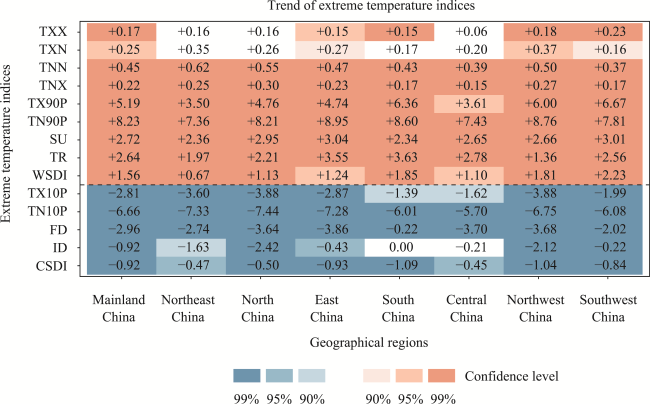
Figure 3 Trends in d/decade or °C/decade of the selected indices estimated using Sen’s slope for seven geographical regions dividing China from 1961 to 2020. The gradient changing from dark to light brown (blue) represents the increasing (decreasing) patterns within the confidence intervals of 99%, 95%, and 90%. The dotted line marks the boundary between the warm and cold indices. |
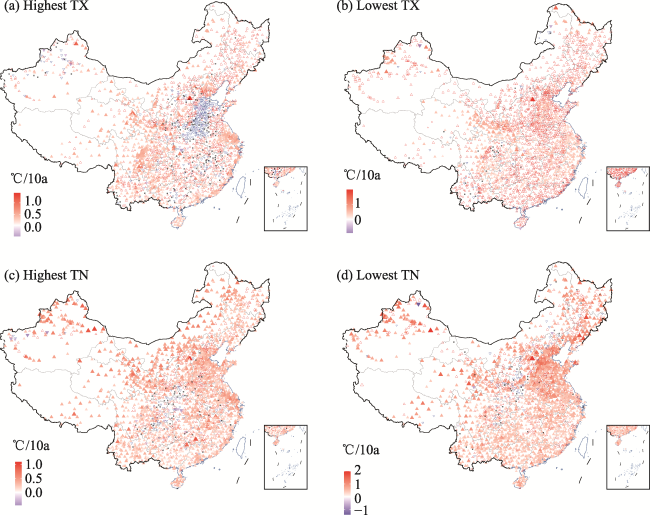
Figure 4 Mapping showing the Mann-Kendall test for TXx, TXn, TNx, and TNn during 1961-2020 in China. Red triangles pointing up and blue triangles pointing down represent statistically significant (α = 0.05) increasing and decreasing trends, respectively. The trend’s magnitude (°C/decade) is indicated by their color and size. Open markers indicate no statistically noteworthy trend at a level of significance of 0.05. Markers with circled crosses indicate stationary trends with Sen’s slope equal to zero. |
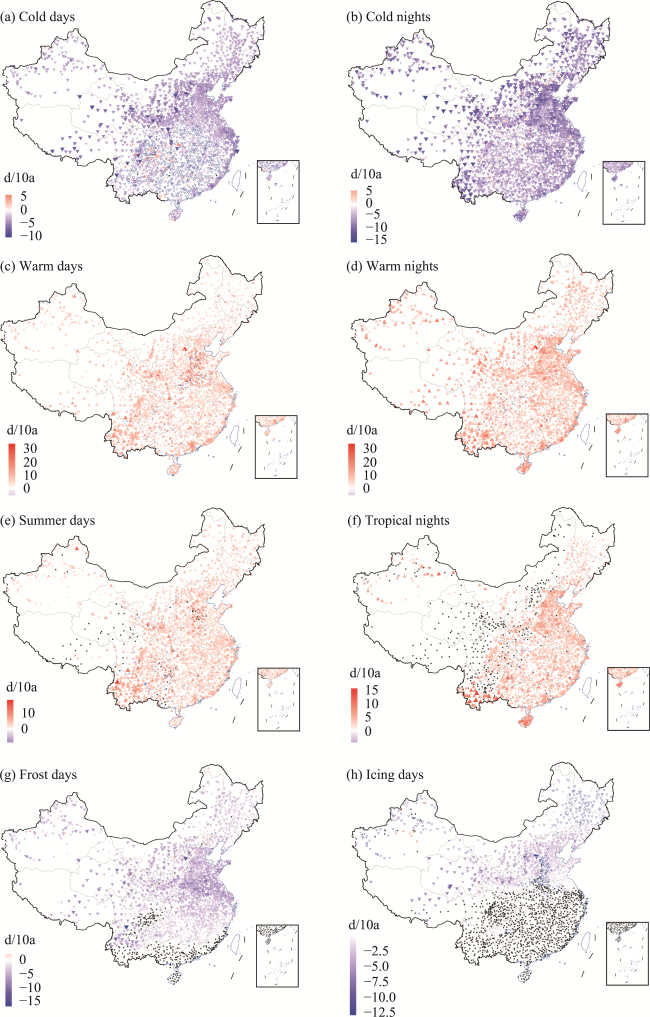
Figure 5 As Figure 4 above, but for 1) percentile-based temperature indices, including TX10p, TN10p, TX90p, TN90p; 2) other temperature indices, including SU, TR, FD, and ID |
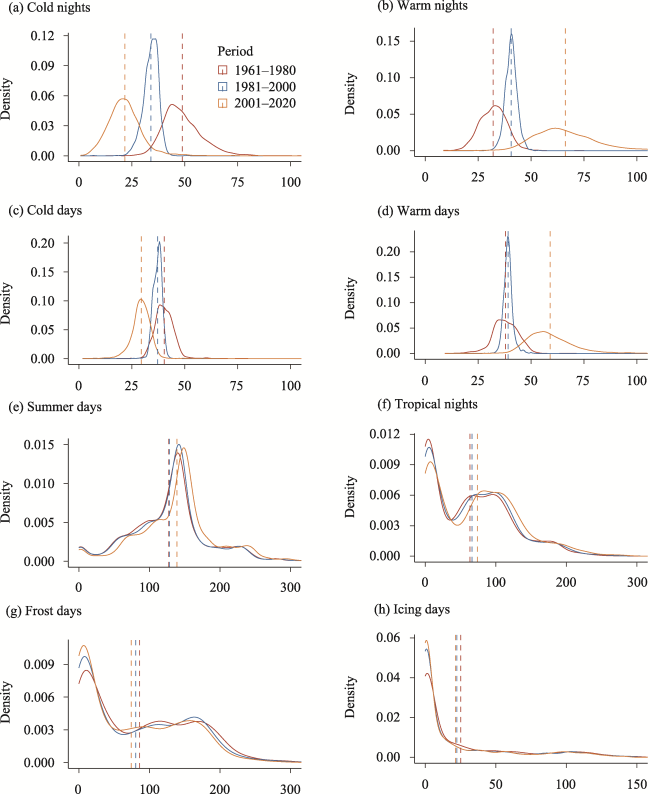
Figure 6 Three periods represented by the following annual probability distribution functions: 1961-1980 (red), 1981-2000 (blue), and 2001-2020 (yellow). The indices include a) cold nights, b) warm nights, c) cold days, d) warm days, e) summer days, f) tropical days, g) frost days, and h) icing days. The dashed line indicates the mean value of each division period. |
Figure 7 Correlation matrix between extreme temperature indicators and atmospheric circulation factors. Significant correlations are marked by * (*p, **p, and ***p<0.001). |
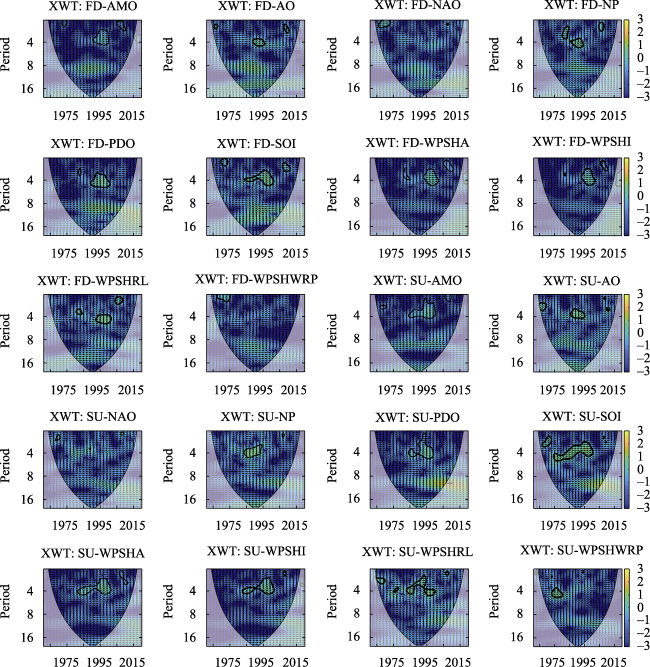
Figure 8 XWT spectra of extreme temperature indices (SU, FD) and atmospheric circulation factors. The cone of influence of wavelet boundary effects is represented by a thin solid U-shaped black line, outside of which power is not considered because of boundary effects. The thick solid black line shows a significant correlation between the two as determined by a red noise test with a 95% confidence level. The left arrow (←) indicates an inverse relationship between the extreme temperature indicator and atmospheric circulation factors, i.e., a negative correlation; the right arrow (→) indicates a direct relationship between the two, i.e., a positive correlation. The up arrow (↑) indicates a lag of 1/4 period of extreme temperature index behind atmospheric circulation factors, and the down arrow (↓) indicates a lead of 1/4 period of extreme temperature index ahead of atmospheric circulation factors. |
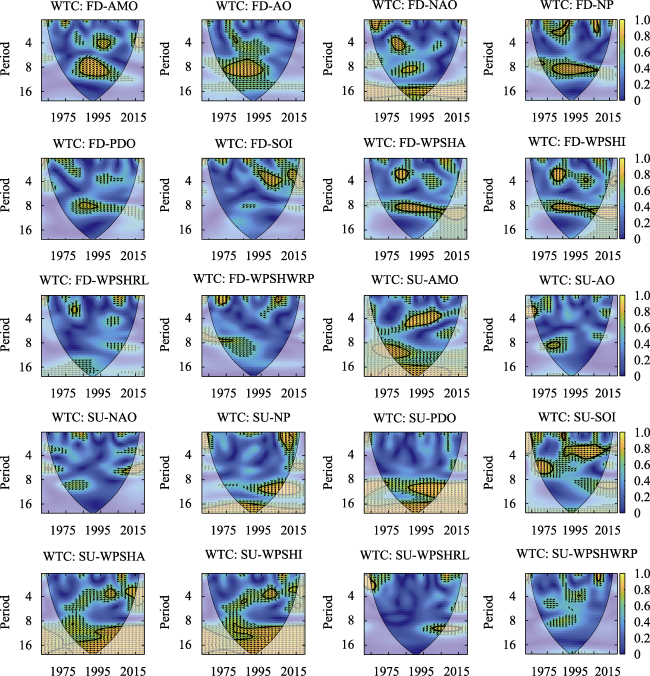
Figure 9 WTC spectra of SU, FD and atmospheric circulation factors |
Table 3 Comparison of extreme temperature trends derived from this study and other studies in China. At the 0.05 significance level, values displayed in bold signify that the trend is considered statistically significant. |
| Index | This study | China | North China (Loess Plateau) | Western China (Tibetan Plateau) | Central and South China (Yangtze River) | Southwest China (Yunnan-Guizhou Plateau) |
|---|---|---|---|---|---|---|
| TN90p | 8.27 | 1.0 | 3.41 | 4.00 | 2.95 | 2.06 |
| TX90p | 5.20 | 0.6 | 2.60 | 3.43 | 1.71 | 2.06 |
| TN10p | -6.67 | -1.1 | -4.31 | -4.92 | -3.45 | -1.35 |
| TX10p | -2.82 | -0.5 | -2.71 | -2.84 | -1.03 | -0.38 |
| TR | 2.67 | 1.9 | 1.24 | - | 1.05 | 2.73 |
| SU | 2.77 | 2.2 | 2.76 | 0.42 | 2.16 | 2.86 |
| ID | -0.92 | -1.0 | -2.21 | -7.74 | -0.42 | - |
| FD | -2.96 | -2.6 | -3.22 | -5.68 | -3.04 | -1.53 |
| WSDI | 1.62 | 0.4 | 0.68 | 3.31 | 0.73 | - |
| CSDI | -0.92 | -1.0 | -0.69 | -2.55 | -1.60 | - |
Note: Temporal scale and data sources: China during 1960-2016 with 794 sites (Wang et al., 2021); North China during 1960-2013 with 72 sites (Sun et al., 2016); Western China during 1971-2011 with 4 sites (Wang et al., 2013); Central and South China during 1960-2012 with 143 sites (Guan et al., 2015); Southwest China during 1960-2019 with 68 sites. |
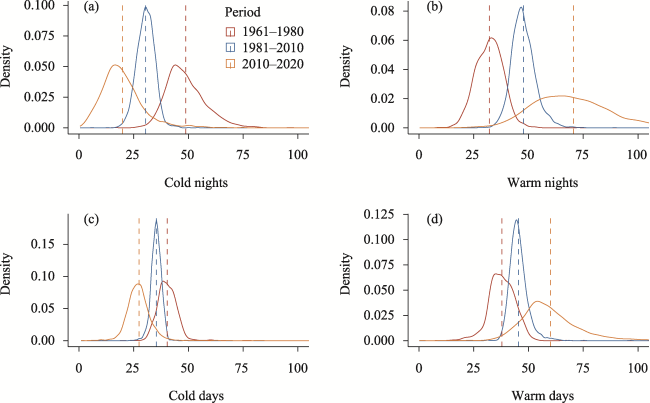
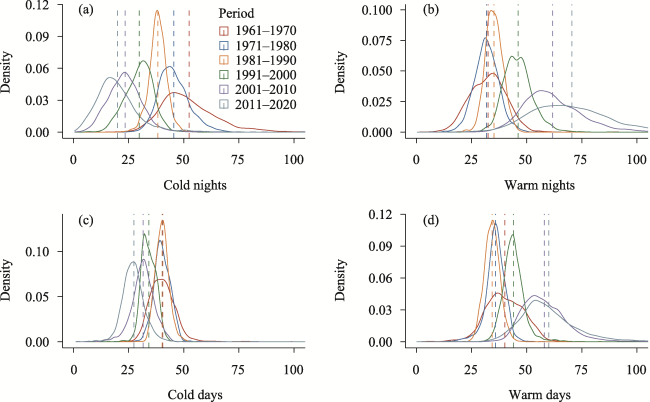
Figure S1 Empirical PDFs of percentile-based temperature indices for the three periods (red, 1961-1980; blue, 1981-2010; and yellow, 2011-2020) |
Figure S2 Empirical PDFs of percentile-based temperature indices for the six consecutive 10-year periods |
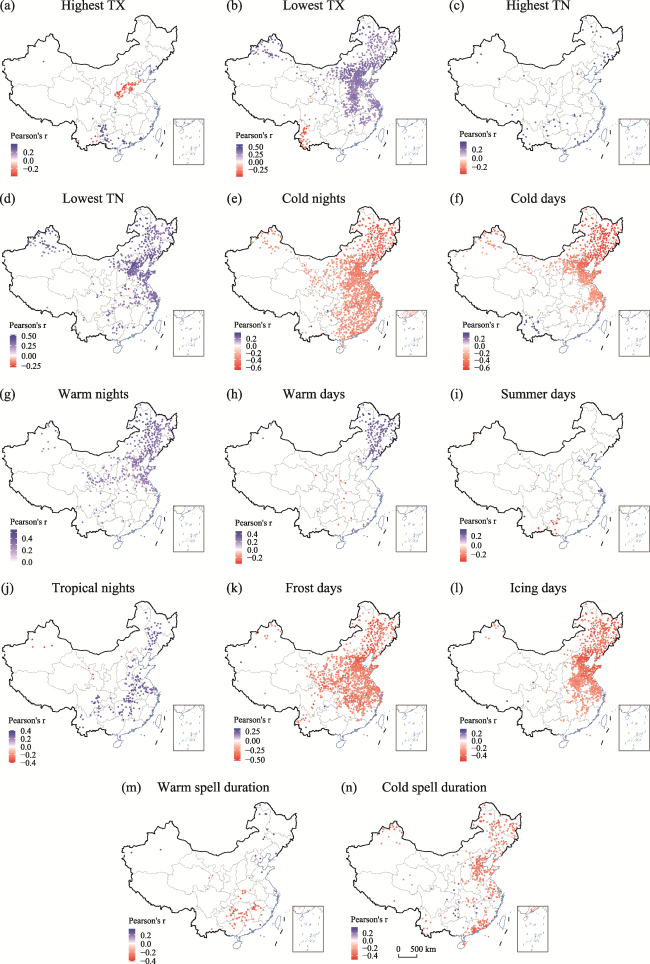
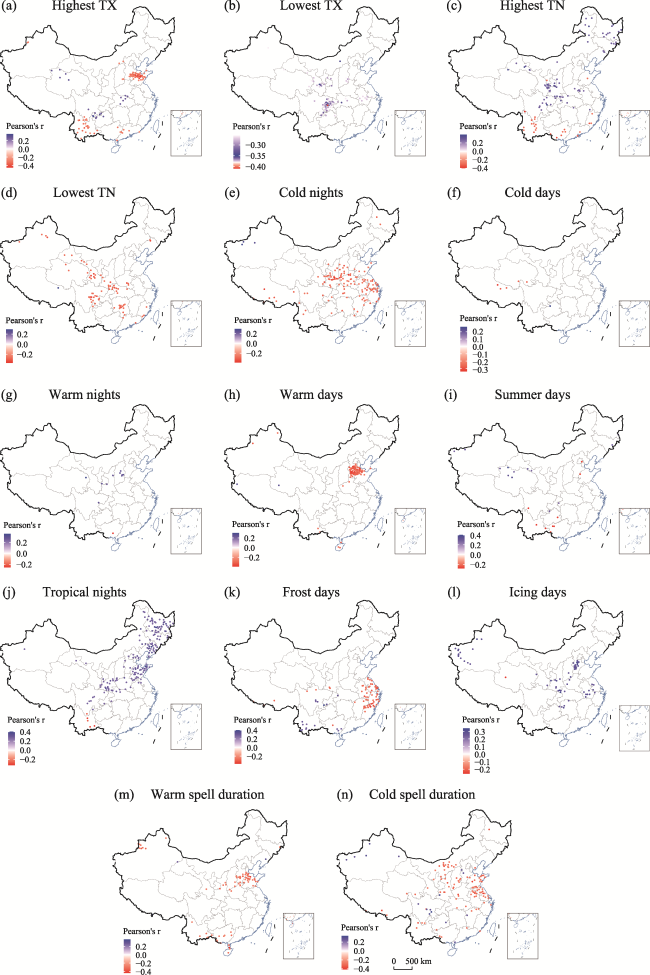
Figure S3 Correlation coefficients between extreme temperature indices and the Arctic Oscillation (AO) in China during 1961-2020. Only meteorological stations with significant correlation (p < 0.05) are shown. |
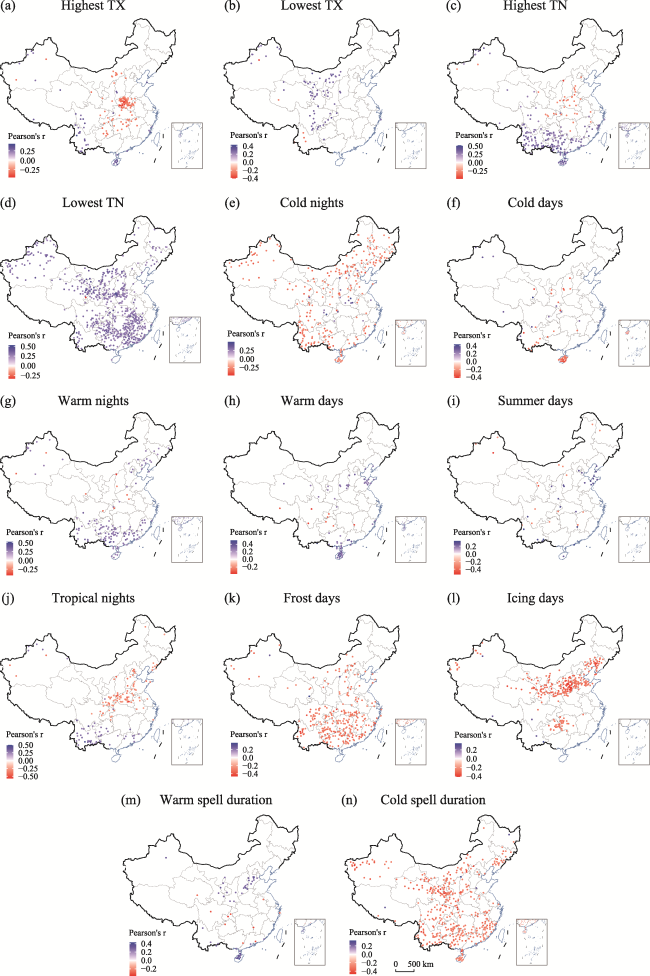
Figure S4 Correlation coefficients between extreme temperature indices and the Pacific Decadal Oscillation (PDO) in China during 1961-2020. Only meteorological stations with significant correlation (p< 0.05) are shown. |
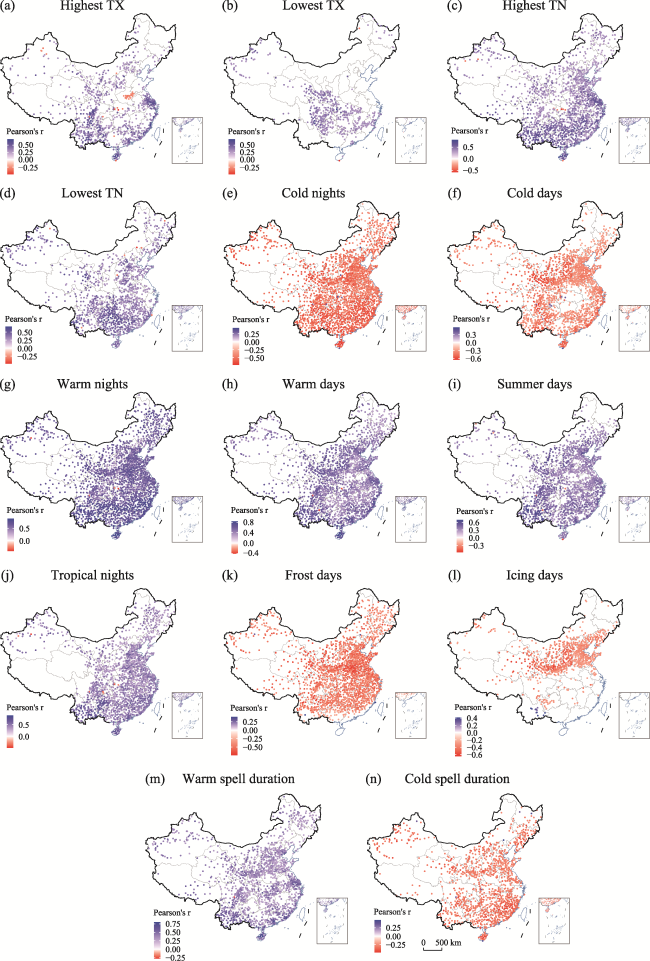
Figure S5 Correlation coefficients between extreme temperature indices and the Subtropical High Intensity index (WPSHI) in China during 1961-2020. Only meteorological stations with significant correlation (p < 0.05) are shown. |
Figure S6 Correlation coefficients between extreme temperature indices and the Subtropical High Western Ridge Point index (WPSHWRP) in China during 1961-2020. Only meteorological stations with significant correlation (p < 0.05) are shown. |
Figure S7 Correlation coefficients between extreme temperature indices and the Subtropical High Ridge Line index (WPSHRL) in China during 1961-2020. Only meteorological stations with significant correlation (p < 0.05) are shown. |
Table S1 Correlation cofficients between extreme temperature index and atmospheric circulation factors in seven regions of China during 1961-2020 |
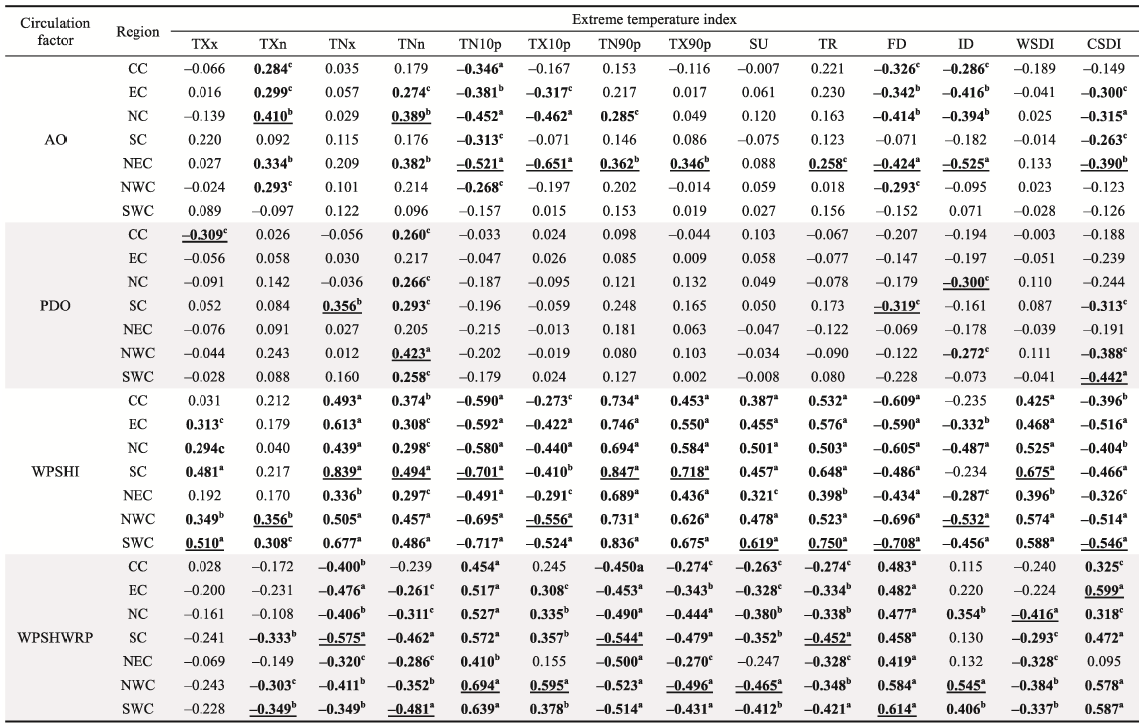 |
Note: a Corelation is snifcant at the 0.001 level; b Correlation is significant at the 0.01 level; c correlation is significant at the 0.05 level. |
| [1] |
|
| [2] |
|
| [3] |
|
| [4] |
|
| [5] |
|
| [6] |
|
| [7] |
|
| [8] |
China Meteorological Administration Climate Change Centre,2021. Blue Book on Climate Change in China 2021. Beijing: Science Press. (in Chinese)
|
| [9] |
|
| [10] |
|
| [11] |
|
| [12] |
|
| [13] |
|
| [14] |
|
| [15] |
|
| [16] |
|
| [17] |
|
| [18] |
|
| [19] |
|
| [20] |
|
| [21] |
|
| [22] |
|
| [23] |
|
| [24] |
|
| [25] |
|
| [26] |
|
| [27] |
|
| [28] |
|
| [29] |
|
| [30] |
|
| [31] |
|
| [32] |
|
| [33] |
|
| [34] |
|
| [35] |
|
| [36] |
|
| [37] |
|
| [38] |
|
| [39] |
|
| [40] |
|
| [41] |
|
| [42] |
|
| [43] |
|
| [44] |
|
| [45] |
|
| [46] |
|
| [47] |
|
| [48] |
|
| [49] |
|
| [50] |
|
| [51] |
|
| [52] |
|
| [53] |
|
| [54] |
|
| [55] |
|
| [56] |
|
| [57] |
|
| [58] |
|
| [59] |
|
| [60] |
|
| [61] |
|
/
| 〈 |
|
〉 |