Journal of Geographical Sciences >
Land use change and its influencing factors along railways in Africa: A case study of the Ethiopian section of the Addis Ababa-Djibouti Railway
|
Zhao Shengbo (1991-), Postdoctoral Researcher, specialized in urbanization and urban planning in Africa. E-mail: shengbo2016@seu.edu.cn |
Received date: 2023-06-03
Accepted date: 2024-02-07
Online published: 2024-09-11
Supported by
National Natural Science Foundation of China(52078115)
Railways are a crucial part of the African transport network and have a significant impact on the socio-economy and urban development. Previous studies have mainly considered the impacts of railways in Africa from the perspective of economy, politics, security, and natural environment with few attempts to consider land use. Based on Landsat remote sensing data for the 10 km buffer zone along the Ethiopian section of the Addis Ababa-Djibouti Railway (ADR) in 2013, 2017, and 2021, we studied the land use change (LUC) in the area and explored its influencing factors using the ordinary least square model (OLS) and geographical weighted regression model (GWR). There were six key results. (1) Farmland, forest, grassland, and others (including sandy land and bare land) were the primary types of land use, but from 2013 to 2021, the area of built-up land and farmland increased, whereas the area of forest, grassland, and other land decreased. (2) There was a noticeable pattern in the degree of change in the area of built-up land, farmland, and forest as the buffer distance increased along the railway. This pattern indicated a gradual shift in land use and LUC gradients. (3) The land use structure and its changes in the areas surrounding different stations displayed obvious differences. (4) The construction and operation of the ADR is one of the direct factors affecting landscape change along the railway. (5) The distance from the train station, whether the station provides a passenger service, the population size, and the distance from the central city had a positive effect on the expansion of built-up land surrounding the station. The factor of whether the station provides a freight service had a negative correlation with the expansion of built-up land. Socio-economic factors have gradually replaced railway factors as the main driving force of the expansion of built-up land around the stations. (6) The effect strength of different factors on the expansion of built-up land varied in the areas surrounding different stations.
Key words: land use; change; railway; influencing factor; Africa
ZHAO Shengbo , QI Junheng , LI Dongxue , WANG Xingping . Land use change and its influencing factors along railways in Africa: A case study of the Ethiopian section of the Addis Ababa-Djibouti Railway[J]. Journal of Geographical Sciences, 2024 , 34(6) : 1128 -1156 . DOI: 10.1007/s11442-024-2242-y
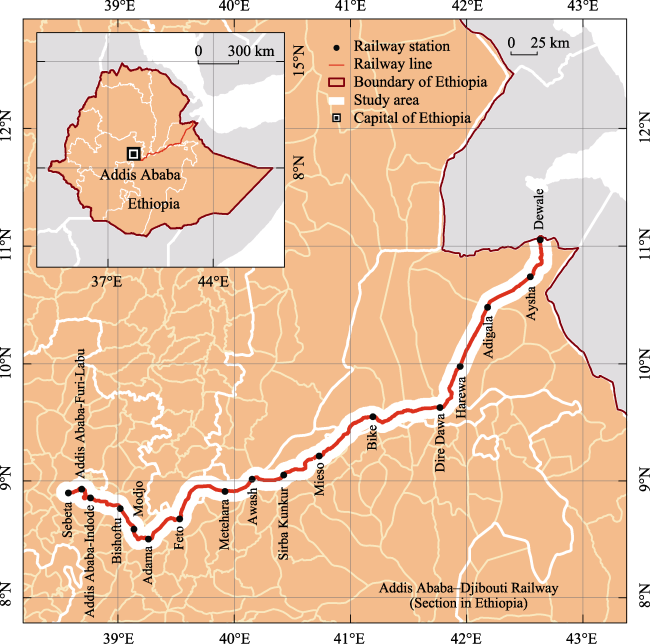
Figure 1 Location of the study area (Ethiopian section of the Addis Ababa-Djibouti Railway) |
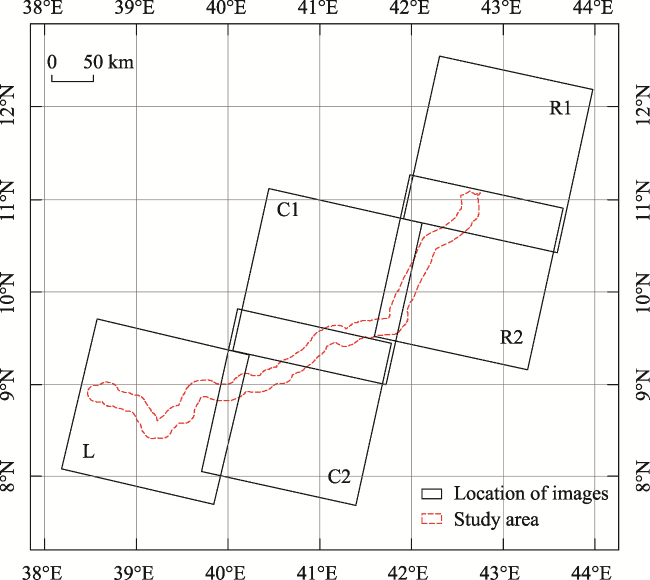
Figure 2 The distribution and index of the Landsat remote sensing images |
Table 1 The date and filename of Landsat remote sensing images |
| 2013 | 2017 | 2021 | ||
|---|---|---|---|---|
| Date | L | 2013.06.08 | 2017.06.03 | 2021.05.29 |
| C1 | 2013.05.16 | 2017.06.12 | 2021.06.07 | |
| C2 | 2013.05.16 | 2017.06.12 | 2021.06.07 | |
| R1 | 2013.06.10 | 2017.06.05 | 2021.05.31 | |
| R2 | 2013.06.10 | 2017.06.05 | 2021.05.31 | |
| Filename | L | LC08_L2SP_168054_2013 0608_20200912_02_T1 | LC08_L2SP_168054_2017 0603_20200903_02_T1 | LC08_L2SP_168054_2021 0529_20210608_02_T1 |
| C1 | LC08_L2SP_167053_2013 0516_20200913_02_T1 | LC08_L2SP_167053_2017 0612_20200903_02_T1 | LC08_L2SP_167053_2021 0607_20210615_02_T1 | |
| C2 | LC08_L2SP_167054_2013 0516_20200912_02_T1 | LC08_L2SP_167054_2017 0612_20200903_02_T1 | LC08_L2SP_167054_2021 0607_20210615_02_T1 | |
| R1 | LC08_L2SP_166052_2013 0610_20200912_02_T1 | LC08_L2SP_166052_2017 0605_20200903_02_T1 | LC08_L2SP_166052_2021 0531_20210608_02_T1 | |
| R2 | LC08_L2SP_166053_2013 0610_20200912_02_T1 | LC08_L2SP_166053_2017 0605_20200903_02_T1 | LC08_L2SP_166053_2021 0531_20210608_02_T1 |
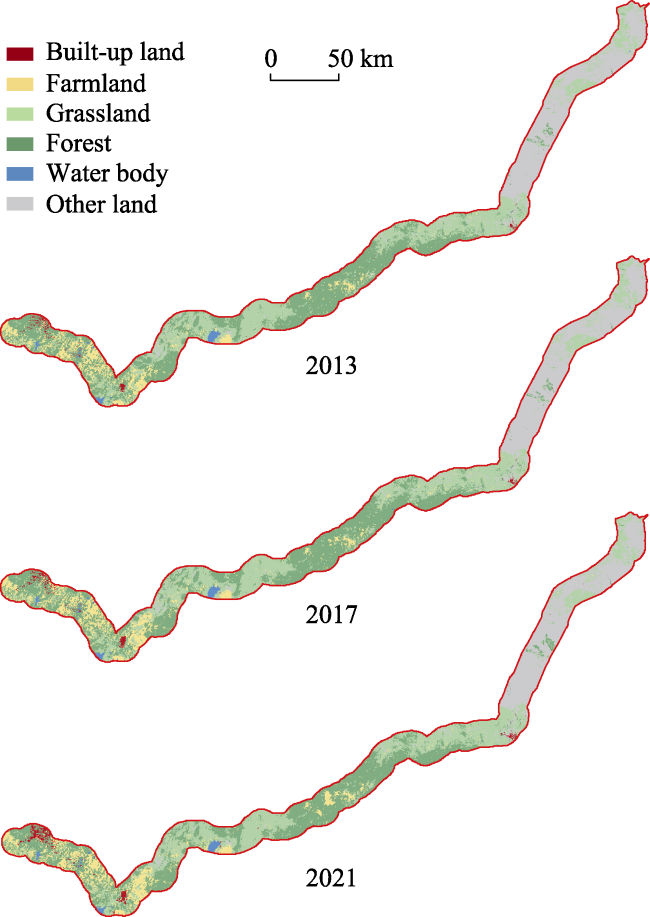
Figure 3 Distribution of land use classification in the study area in different time periods |
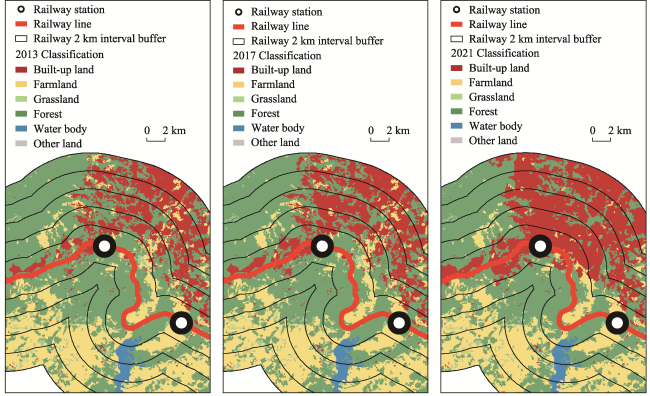
Figure 4 An enlarged map of the five buffer zones at 2 km intervals and the spatial distribution of land use along the railway line with Addis Ababa at the center in different time periods |
Table 2 Proportion of land use types in different time periods |
| Land use type | 2013 | 2017 | 2021 | |||
|---|---|---|---|---|---|---|
| Area (km2) | Percentage (%) | Area (km2) | Percentage (%) | Area (km2) | Percentage (%) | |
| Built-up land | 254.05 | 1.91 | 293.61 | 2.21 | 375.02 | 2.82 |
| Farmland | 1980.16 | 14.91 | 2160.50 | 16.27 | 2250.52 | 16.94 |
| Forest | 4857.70 | 36.57 | 4678.44 | 35.22 | 4592.27 | 34.57 |
| Grassland | 3679.61 | 27.70 | 3639.53 | 27.40 | 3581.19 | 26.96 |
| Other land | 2428.08 | 18.28 | 2427.51 | 18.28 | 2400.60 | 18.07 |
| Water body | 83.21 | 0.63 | 83.22 | 0.63 | 83.22 | 0.63 |
| Total | 13282.82 | 100 | 13282.82 | 100 | 13282.82 | 100 |
Table 3 Range of land use change in different time periods |
| 2013-2017 | 2017-2021 | 2013-2021 | |
|---|---|---|---|
| Built-up land | 15.57% | 27.73% | 47.61% |
| Farmland | 9.11% | 4.17% | 13.65% |
| Forest | -3.69% | -1.84% | -5.46% |
| Grassland | -1.09% | -1.60% | -2.67% |
| Other land | -0.02% | -1.11% | -1.13% |
| Water body | 0.01% | 0.00% | 0.01% |
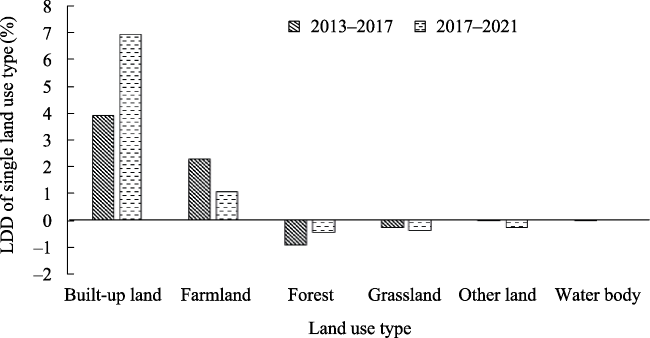
Figure 5 Land use dynamic degree (LDD) of single land use type in different periods |
Table 4 Land use dynamic degree (LDD) of comprehensive land use type in different periods |
| Period | 2013-2017 | 2017-2021 |
|---|---|---|
| LDD of comprehensive land use types (%) | 0.45 | 0.42 |
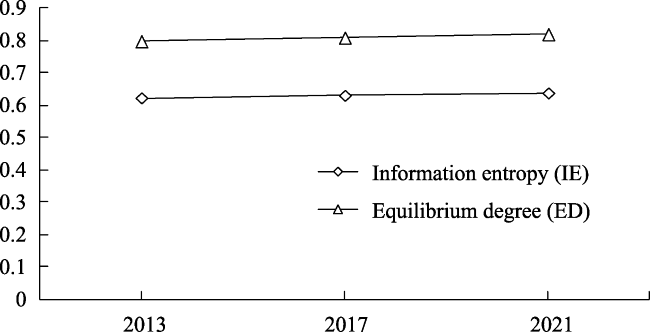
Figure 6 Information entropy (IE) and equilibrium degree (ED) of land use in different years |
Table 5 Land use transfer matrix in different periods |
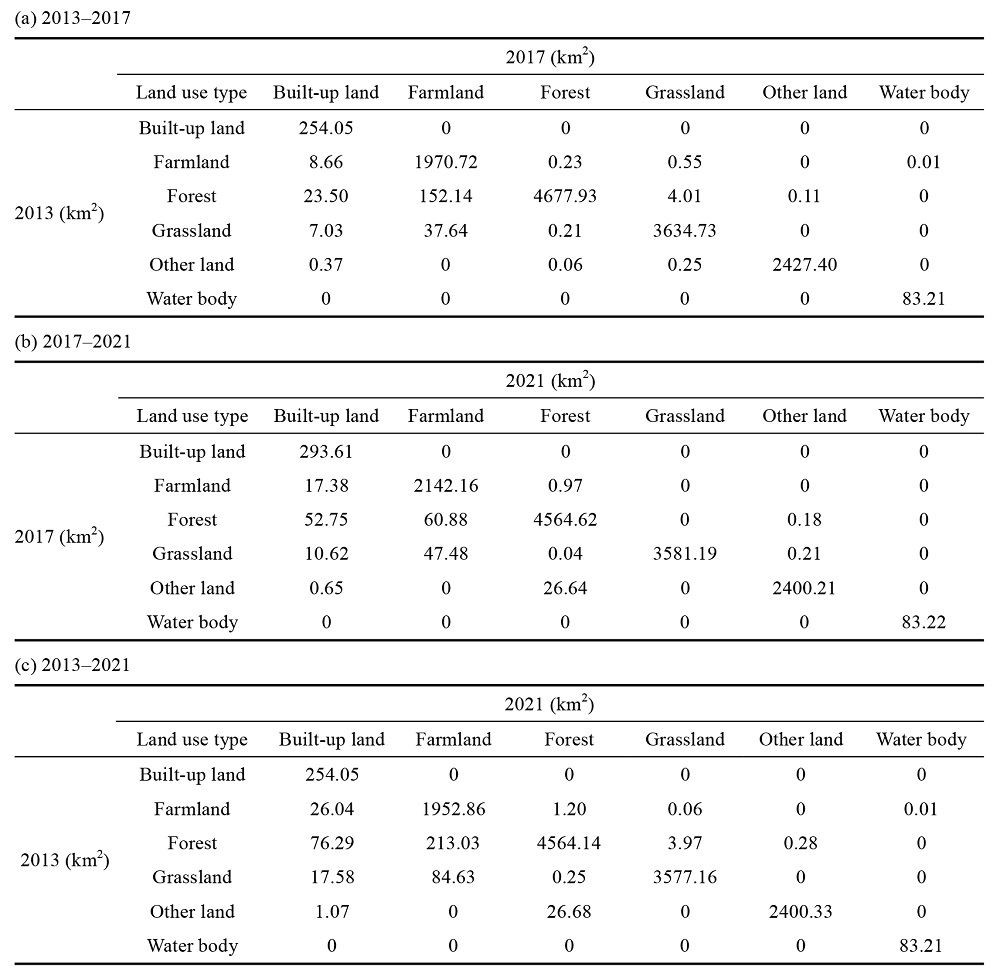 |
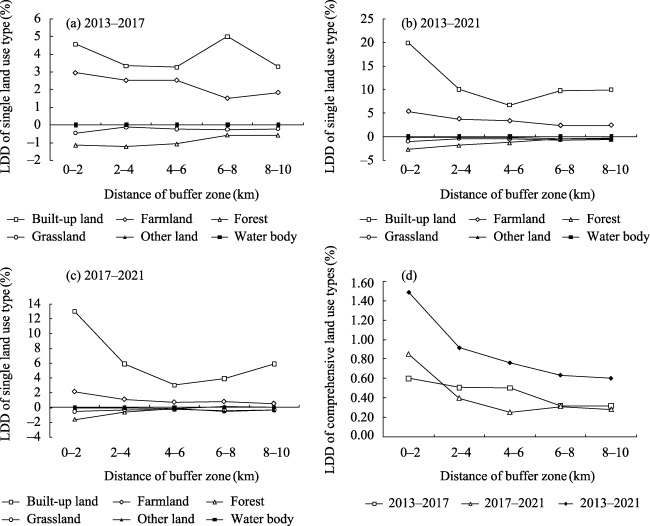
Figure 7 Relationship between land use dynamic degrees of land use change and buffer distance in each period |
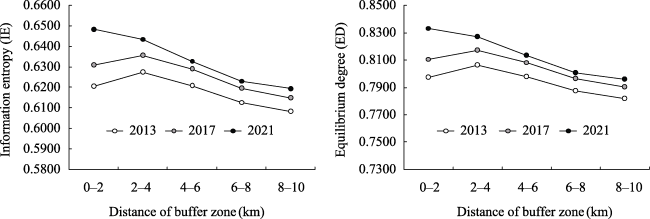
Figure 8 Information entropy and equilibrium degree of land use in each buffer zone in different periods |
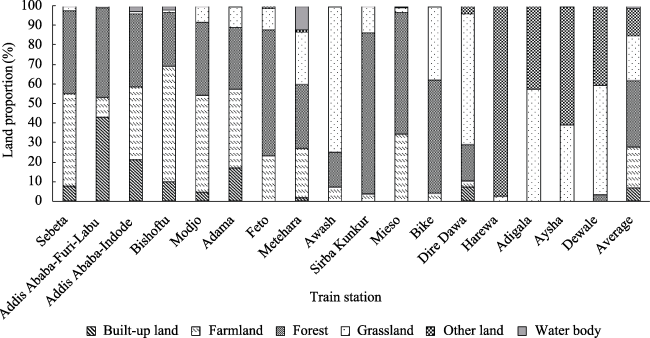
Figure 9 Land use structure of the buffer zones with a radius of 10 km around the stations along the Ethiopian section of the Addis Ababa-Djibouti Railway in 2021 |
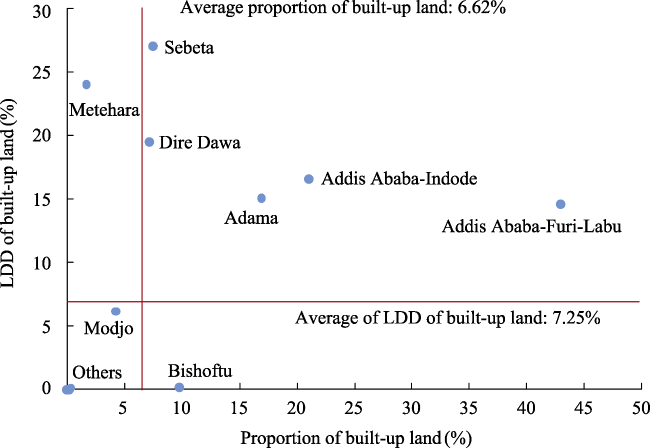
Figure 10 Proportion of built-up land in 2021 and land use dynamic degree (LDD) of built-up land from 2013 to 2021 of the buffer zones with a radius of 10 km around the stations along the Ethiopian section of the Addis Ababa-Djibouti RailwayNote: “Others” includes Feto, Awash, Sirba Kunkur, Mieso, Bike, Harewa, Adigala, Aysha, and Dewale. |
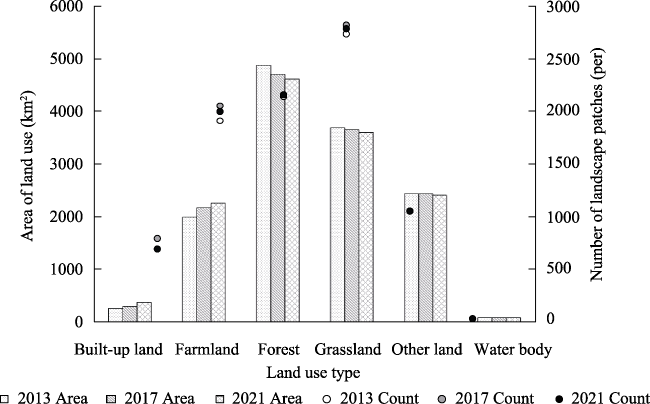
Figure 11 Change in land area and number of landscape patches in the Ethiopian section of the Addis Ababa-Djibouti Railway |
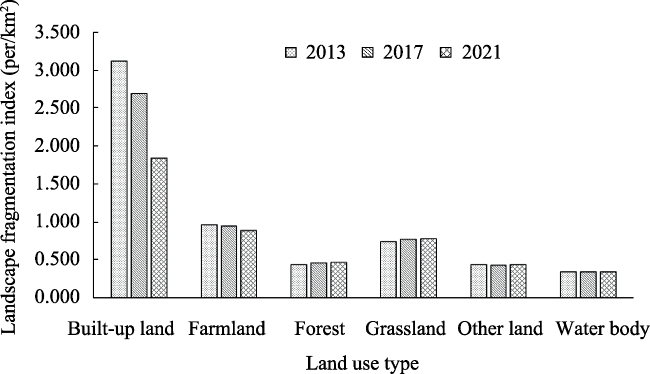
Figure 12 Landscape fragmentation index of different land use types in the Ethiopian section of the Addis Ababa-Djibouti Railway |
Table 6 The influencing factors of built-up land expansion in the area around stations |
| Variable type | Variable category | Variable | Data source |
|---|---|---|---|
| Dependent variable | Built-up land expansion | The proportion of built-up land in the space unit | Land use data |
| Explanatory variable | Railway factor | Distance from the train station | Railway station geolocation by Open Street Map |
| Distance from railway line | Railway line shapefile by Open Street Map | ||
| Whether nearby station provides passenger service | Operation strategy of ADR from the ADR Operation and Maintenance Project Company | ||
| Whether nearby station provides freight service | |||
| Natural environmental factor | Slope | DEM | |
| Vegetation coverage | Landsat-OLI | ||
| Social economic factor | Population size | LandScan | |
| Distance from the central city | Central city geolocation |
Note: We identified several typical central cities in Ethiopia along the ADR by the size of urban space and population, including Addis Ababa, Bishoftu, Adama and Dire Dawa. |
Table 7 Fitting degree comparison between OLS Model and GWR Model in 2013 and 2021 |
| 2013 | 2021 | |||
|---|---|---|---|---|
| OLS | GWR | OLS | GWR | |
| -2 log-likelihood | -1207.75 | -1496.56 | -1139.96 | -1361.77 |
| Classic AIC | -1187.75 | -1410.23 | -1119.96 | -1279.05 |
| AICc | -1187.35 | -1402.87 | -1119.56 | -1272.30 |
| BIC/MDL | -1144.44 | -1223.28 | -1076.64 | -1099.90 |
| CV | 0.0073 | 14384.42 | 0.0081 | 141.19 |
| R2 | 0.5681 | 0.7417 | 0.7490 | 0.8309 |
| Adjusted R2 | 0.5611 | 0.7207 | 0.7449 | 0.8177 |
Table 8 Estimation results of influencing factors of built-up land expansion based on OLS |
| 2013 | 2021 | 2013 | 2021 | ||
|---|---|---|---|---|---|
| Distance from the train station | -0.0737** | -0.0487* | Vegetation coverage | -0.0586** | -0.0056 |
| (0.0444) | (0.0821) | (0.0421) | (0.7959) | ||
| Distance from railway line | 0.0082 | -0.0238 | Population size | 0.6386*** | 0.7895*** |
| (0.8198) | (0.3843) | (0.0000) | (0.0000) | ||
| Whether nearby station provides passenger service | 0.1653*** | 0.0831*** | Distance from the central city | -0.2083*** | -0.1314*** |
| (0.0000) | (0.0020) | (0.0000) | (0.0000) | ||
| Whether nearby station provides freight service | -0.1587*** | -0.0641** | Constant | 0.0000 | -0.0000 |
| (0.0000) | (0.0170) | (1.0000) | (1.0000) | ||
| Slope | 0.0140 | 0.0309 | |||
| (0.6293) | (0.1627) |
Note: The coefficient in brackets represents the standard deviation of the influencing factor, with * representing p < 0.10, ** representing p < 0.05, and *** representing p < 0.01. |
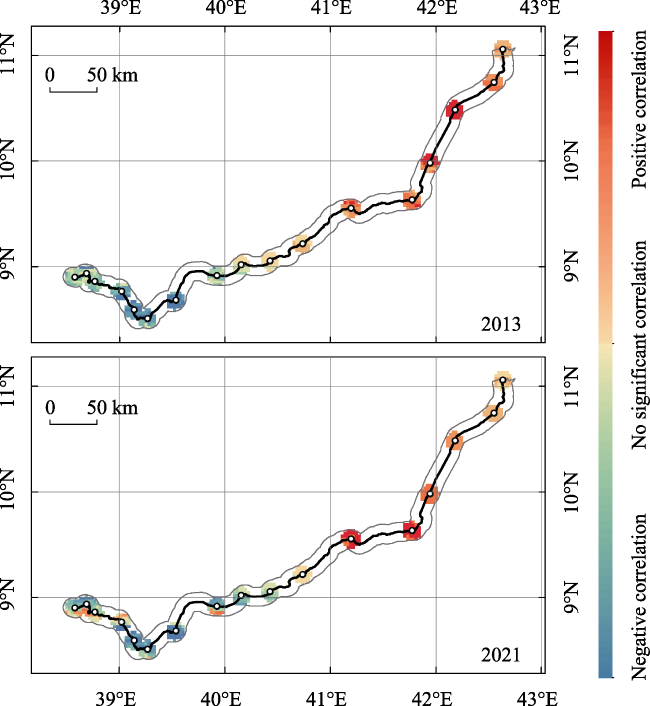
Figure 13 Spatial distribution of the distance from the train station in the GWR Model |
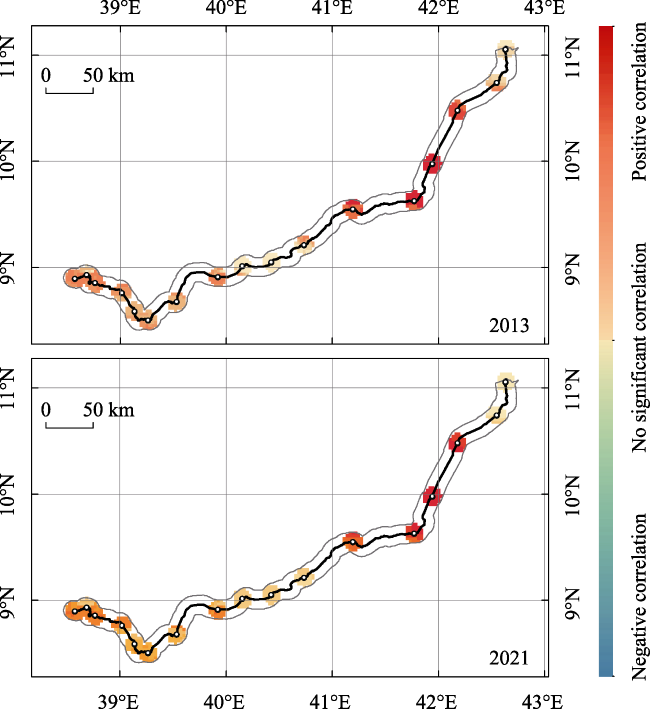
Figure 14 Spatial distribution of the population size in the GWR Model |
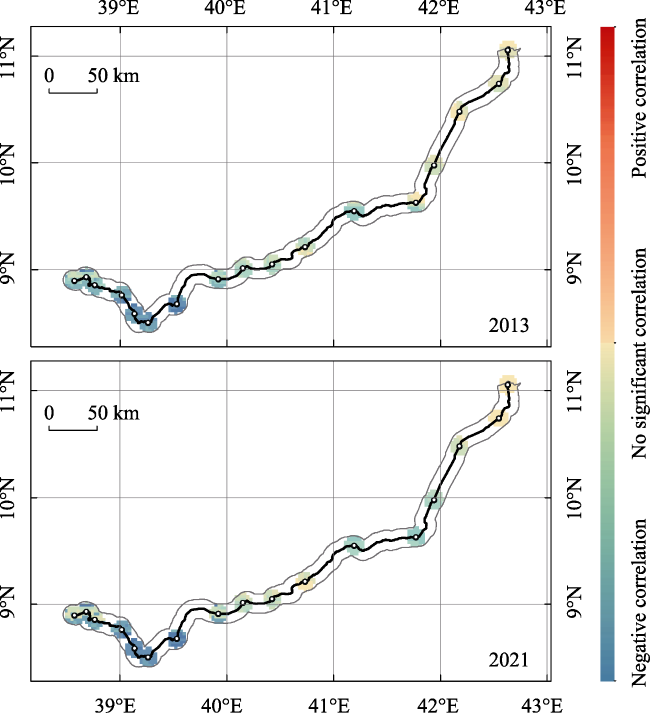
Figure 15 Spatial distribution of the distance from the central city in the GWR Model |
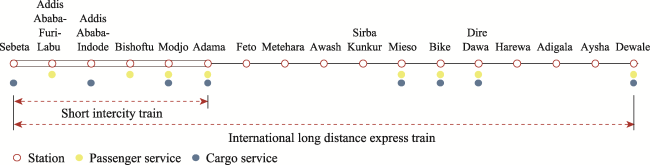
Figure 16 Operation strategy of the Ethiopian section of the Addis Ababa-Djibouti Railway |
| [1] |
Baike, 2022. Addis Ababa-Djibouti Railway. Available at: https://baike.baidu.com/item/%E4%BA%9A%E5%90%89%E9%93%81%E8%B7%AF/20123454?fr=aladdin#2_2. Cited 02 March 2022.
|
| [2] |
|
| [3] |
|
| [4] |
|
| [5] |
|
| [6] |
|
| [7] |
|
| [8] |
|
| [9] |
|
| [10] |
|
| [11] |
|
| [12] |
|
| [13] |
|
| [14] |
|
| [15] |
|
| [16] |
|
| [17] |
|
| [18] |
|
| [19] |
|
| [20] |
|
| [21] |
|
| [22] |
|
| [23] |
|
| [24] |
|
| [25] |
|
| [26] |
|
| [27] |
|
| [28] |
|
| [29] |
|
| [30] |
|
| [31] |
|
| [32] |
|
| [33] |
|
| [34] |
|
| [35] |
|
| [36] |
|
| [37] |
|
| [38] |
|
| [39] |
|
| [40] |
UIC, 2020. Update on the African integrated high-speed railway network by AUDA-NEPAD. Available at: https://uic.org/com/enews/nr/700/article/update-on-the-african-integrated-high-speed-railway-network-by-auda-nepad?page=modal_enews. Cited 20 March 2022.
|
| [41] |
|
| [42] |
|
| [43] |
|
| [44] |
|
| [45] |
|
| [46] |
|
| [47] |
|
| [48] |
|
| [49] |
|
| [50] |
|
/
| 〈 |
|
〉 |